 PocketProof
On a $75,000 salary, the 20/4/10 rule puts your maximum safe car price at roughly $18,450. That surprises most people the first time they run it, because it's usually a lot lower than what a dealer or lender is willing to approve.
What the 20/4/10 rule actually means
The 20/4/10 rule is a budgeting guideline, not a loan qualification standard. It's designed to protect you, not the lender. Three numbers make it up:
The three formulas
- Down payment requirement: Purchase Price × 0.20 — put at least 20% down in cash or trade-in value.
- Loan duration limit: 48 months (4 years) maximum — longer terms hide the real cost behind a smaller monthly number.
- Monthly transportation allowance cap: Gross Monthly Income × 0.10 — and this figure has to cover principal, interest, insurance, fuel, and maintenance combined, not just the loan payment.
That third formula is where most people's math goes wrong — they calculate 10% of their income and assume that whole amount can go toward a car payment. It can't. Insurance and fuel come out of that same 10% first.
The exact math on a $75,000 salary
Here's the full calculation, step by step, using a gross salary of $75,000/year with typical insurance and fuel costs.
- Find the monthly transport cap. $75,000 ÷ 12 = $6,250/month gross income. $6,250 × 0.10 = $625/month total transportation allowance.
- Subtract insurance and fuel/upkeep. Assume $150/month for insurance and $125/month for gas and routine maintenance — $275 total. $625 − $275 = $350/month left over for the actual loan payment (principal + interest).
- Find the maximum loan amount. Financing $350/month over 48 months at a typical ~6.5% APR works out to a maximum loan amount of approximately $14,760.
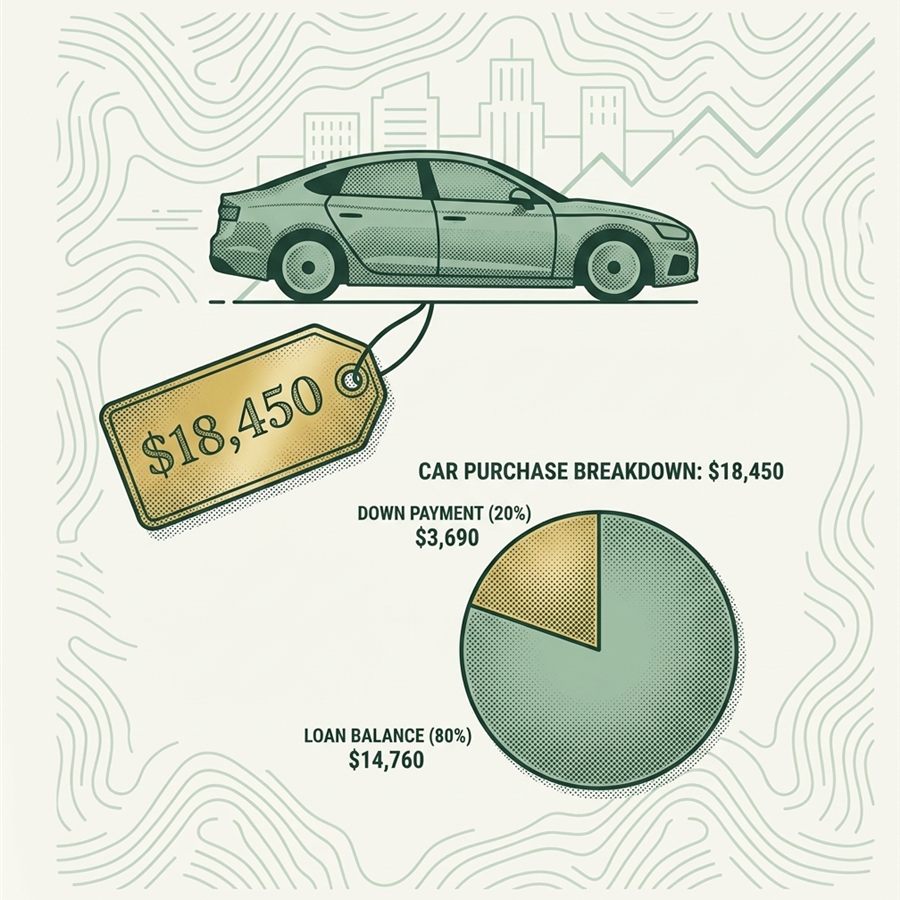
- Add the required 20% down payment. Since the down payment is 20% of the total price, the loan covers the remaining 80% — so total price = loan amount ÷ 0.80 = $14,760 ÷ 0.80 = a required down payment of roughly $3,690.
- Total it up. $14,760 loan + $3,690 down payment = a maximum safe sticker price of about $18,450.
How this scales at other salaries
The purchase price grows faster than salary once you clear the fixed $275 insurance-and-fuel floor, because that floor eats a much bigger share of the 10% cap at lower incomes.
| Annual salary | $50,000 | $75,000 | $100,000 |
|---|---|---|---|
| Gross monthly income | $4,167 | $6,250 | $8,333 |
| Max transport spend (10% cap) | $417 | $625 | $833 |
| Max loan payment (after insurance & fuel) | $142 | $350 | $558 |
| Max recommended purchase price | ~$7,450 | ~$18,450 | ~$29,400 |
Notice that going from $50K to $75K (a 50% raise) more than doubles the safe purchase price. That's the fixed-cost floor at work — it's worth knowing whether you're budgeting at the lower or higher end of your own income range.
Where this math breaks down if you're not careful
Three specific decisions can quietly wreck this math even if you've calculated everything else correctly:
Stretching the loan to 72 months
A longer term lowers the monthly payment, which can make a car above your real budget "fit" on paper — but it doesn't lower what the car actually costs. You pay more total interest, and you stay financially underwater on the loan (owing more than the car is worth) for longer. If $350/month only qualifies you for an $18,450 car over 48 months, stretching to 72 months to afford a $24,000 car means borrowing the difference at a worse rate than the loan itself.
Underestimating insurance before you sign
This entire calculation depends on the $150/month insurance estimate holding up. Insurance varies enormously by make, model, age, and driving record — get an actual quote for the specific car before you sign anything, not after. A $75/month miss on insurance eats more than 20% of your $350 loan-payment budget.
Ignoring the 5-year total cost of ownership
The purchase price and loan payment are only part of the real cost. Maintenance, depreciation, and registration fees add up differently for a used car versus a lease versus a new purchase — sometimes enough to change which option is actually cheaper over 5 years, even when the sticker price looks similar. See our verified 5-year lease vs. new vs. used comparison for the full math and a calculator to run your own numbers.

Run your own numbers before you shop — plug your real income, credit score, and an actual insurance quote into our free car affordability calculator to get a figure tailored to you instead of this $75K example.