 PocketProof
Longer auto loans get pitched as a way to afford more car for less money each month, and on the payment line, that's technically true. What the smaller number doesn't show is the two things happening underneath it: you're paying interest for a lot more months, and the loan balance drops slower than the car's value does — which means you spend longer owing more than the car is actually worth. Neither of those show up on the sticker or the "as low as" payment ad.
The interest cost, verified
Same $30,000 loan, same 6.5% rate — the only thing that changes across these is the term length:
| Term | Monthly payment | Total interest paid |
|---|---|---|
| 36 months | $919.47 | $3,100.92 |
| 48 months | $711.45 | $4,149.53 |
| 60 months | $586.98 | $5,219.07 |
| 72 months | $504.30 | $6,309.45 |
| 84 months | $445.48 | $7,420.58 |
Going from 60 to 72 months lowers the payment by $82.69 a month — genuinely useful if that's the difference between fitting a car into your budget or not. It also adds $1,090.38 in interest over the life of the loan, and stretches the commitment out an extra year. Neither number is wrong to accept, but both are worth actually seeing before signing, not discovering later.
Compare two terms yourself
Plug in your own loan amount, rate, and the two terms you're actually deciding between.
Loan term comparison calculator
The part that's easy to miss: how long you're "underwater"
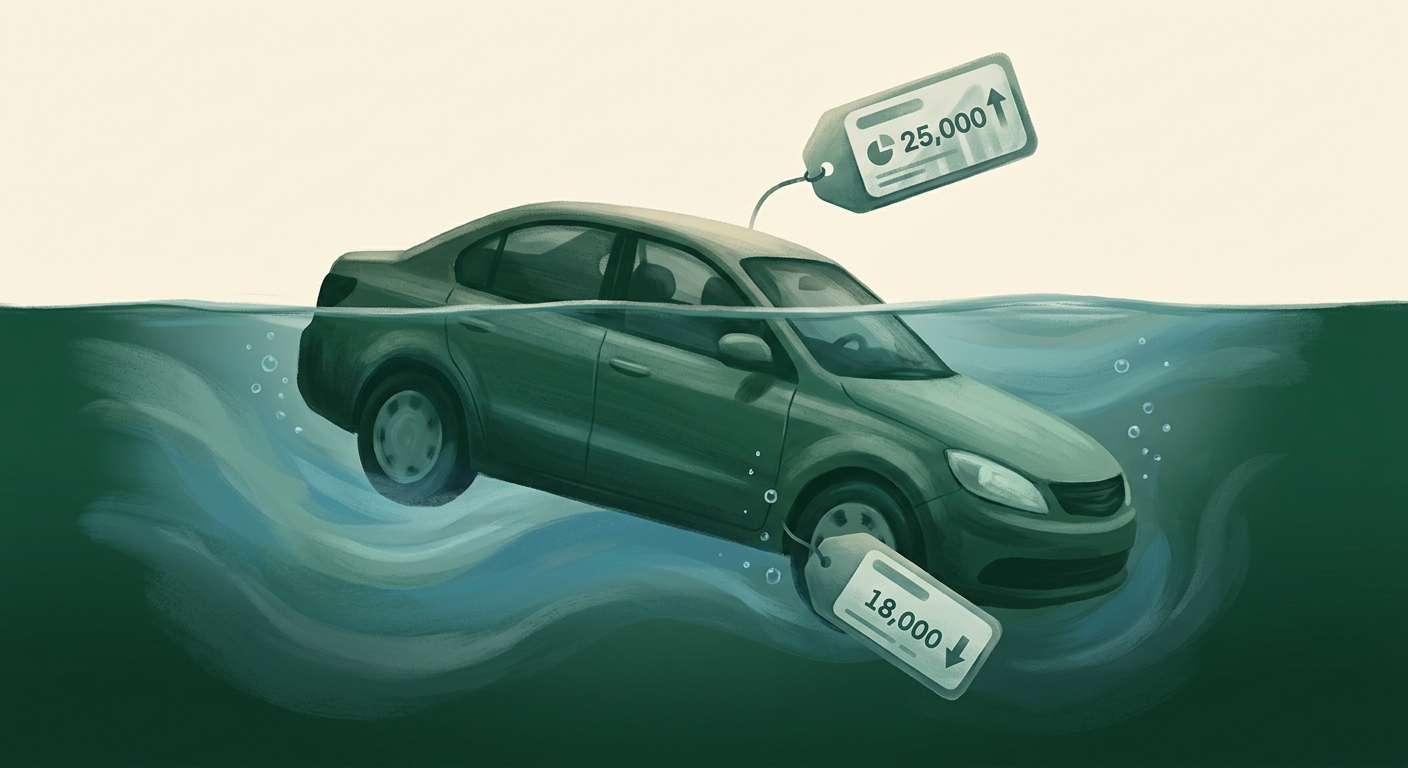
A car loan balance drops in a straight, predictable line. A car's value doesn't — it drops fast in year one (commonly estimated around 20%), then keeps declining a bit slower each year after. A longer loan pairs a slow-dropping balance with a fast-dropping value, which stretches out the window where you owe more than the car is worth.
| Month | Est. car value | 60-month balance / equity | 72-month balance / equity |
|---|---|---|---|
| 12 | $24,000 | $24,752 / -$752 | $25,774 / -$1,774 |
| 24 | $21,120 | $19,152 / +$1,968 | $21,265 / -$145 |
| 36 | $18,586 | $13,177 / +$5,409 | $16,454 / +$2,132 |
| 48 | $16,355 | $6,802 / +$9,553 | $11,321 / +$5,035 |
| 60 | $14,393 | $0 / +$14,393 | $5,844 / +$8,549 |
At the two-year mark, the 60-month loan has already crossed into positive equity — the car's worth more than what's left on the loan. The 72-month loan on the identical car and price is still $145 underwater at that same point, and doesn't clear it until sometime in year three. That gap matters most if life happens — the car gets totaled, you need to trade it in, or you just want to sell — while you're still upside down: insurance pays out the car's actual value, not your loan balance, and the difference comes out of your pocket unless you specifically carry gap insurance.
This doesn't mean a longer term is always the wrong call
Sometimes a longer term is genuinely the only way to fit a reliable car into a tight budget, and a reliable car you can actually afford beats an unreliable one you can't, or no car when you need one for work. The point isn't to feel bad about a 72-month loan — it's knowing the real cost and the real underwater window going in, so it's a decision made on purpose instead of one that just felt like "the payment that fit."
If you haven't already worked out what you can actually afford before the term-length decision even comes up, start with our car affordability guide and the 20/4/10 rule breakdown — both help you land on a price and payment range first, which makes the term-length tradeoff here a much smaller decision. And if you're already in a longer loan and reconsidering it, our lease buyout math walks through a related real example of exiting a car commitment early using actual numbers.