 PocketProof
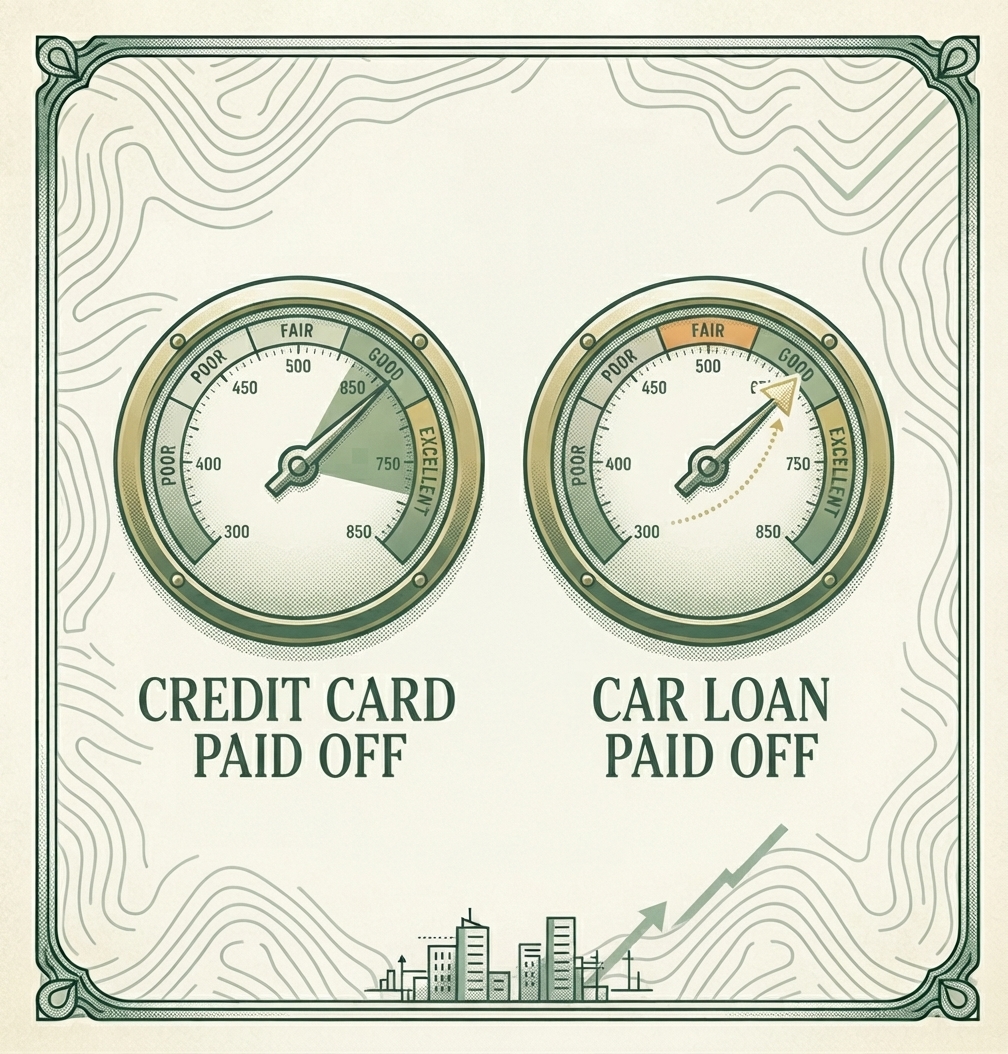
Paying off a credit card and paying off a car loan affect your credit score in opposite directions. One almost always helps. The other can cause a small dip before it recovers. Which one you just did determines what you should actually expect to see the next time you check.
The two credit factors that actually move when you pay off debt
A FICO score is built from five weighted factors, and paying off debt only really touches two of them:
- Amounts owed / credit utilization (30% of your score) — how much of your available revolving credit (credit cards) you're using. This is the factor that moves fast.
- Credit mix (10% of your score) — how varied your account types are: revolving (cards) versus installment (auto, personal, student, mortgage loans). This is the factor that can work against you.
Payment history (35%), length of credit history (15%), and new credit (10%) barely move after a payoff, since they already reflect your track record, and closing a paid-off account doesn't erase that history from your report.
| Credit factor | Weight | Paying off a credit card | Paying off an installment loan |
|---|---|---|---|
| Payment history | 35% | No change | No change |
| Amounts owed (utilization) | 30% | Drops — often the single biggest boost you can give your score | Unaffected — installment balances don't count toward revolving utilization |
| Length of credit history | 15% | No change if the card stays open | Neutral, or slightly negative later if it closes and was one of your older accounts |
| Credit mix | 10% | No change | Can dip slightly if it was your only installment loan |
| New credit | 10% | No change | No change |
Paying off a credit card: almost always good news
Utilization is measured as a percentage of your available revolving credit that's currently in use, and it's one of the most responsive factors in the entire scoring model — it can move within a single billing cycle. Paying off a card (and keeping it open) drops your utilization immediately, which is why this is the single fastest lever most people have to raise their score on purpose.
Paying off an installment loan: the surprising part
An installment loan — a car loan, a personal loan, a student loan — doesn't factor into revolving utilization at all, so paying it off doesn't give you that same boost. What it can do is shrink your credit mix if it was your only installment account, since your report now leans more heavily toward just revolving credit. For some people, that shows up as a small, temporary score dip in the weeks after the loan closes — not because paying it off was a mistake, but because one input to the scoring model narrowed.
What will happen to your score?
Answer three questions about what you just paid off:
What to expect after your payoff
Not a calculator — no formula can predict an exact score change, since the algorithm is proprietary. This walks through the same logic loan officers and credit counselors use to set expectations.
What type of account did you just pay off?
Was this the card carrying your highest balance relative to its limit?
Was this your only installment loan (no mortgage, no other auto or personal loan still open)?
Do you have several other accounts (credit cards) still open and in good standing?
You paid off the balance that was doing the most damage to your utilization ratio — this is the single most responsive factor in the scoring model, so expect a meaningful, fairly quick improvement.
Your utilization still improved, so expect a positive move — just not as large as if this had been your highest-balance card.
You still have other installment accounts open, so your credit mix didn't narrow. Expect close to no movement from this factor either way.
Your credit mix narrowed a bit, but your other open accounts keep contributing positive payment history the whole time — this kind of dip is usually small and short-lived.
With little else on your file, losing your only installment account has more room to move the mix factor. It's still typically a modest, recoverable dip — not a reason to have kept paying interest longer than necessary.
A typical example
David pays off his last $4,000 car loan — his only installment account, alongside three credit cards he keeps under 10% utilization. In the weeks after the loan closes, his score commonly drops in the range other people in this exact situation report seeing: a handful of points, not a cliff. Over the following three to four months, as his cards continue reporting on-time payments, his score recovers to at or above where it started.
Unlike the math elsewhere on this site, this range isn't something we can verify with a formula — FICO's model isn't public, and results vary by scoring version, bureau, and the rest of your credit file. Treat it as a realistic pattern, not a guarantee.
Should this change whether you pay off debt?
No. A temporary few-point dip is not a reason to keep paying interest on a loan you could otherwise clear. If you're deciding which debt to tackle first, our debt snowball vs. avalanche comparison covers the actual math and psychology of that choice — the credit score effect described here is a minor side note next to the interest you save by paying debt off on purpose.
If a card's interest rate is the real obstacle rather than the payoff itself, see our credit card APR negotiation script — lowering the rate first can make the payoff faster without touching your credit mix at all.
If you're starting from a thin or damaged file rather than fine-tuning an existing one, our 12-month credit rebuild checklist walks through the same five factors from the ground up.