 PocketProof
A car starts losing value the second it's driven off the lot, and it keeps losing value every year after that, no matter who owns it or how they paid for it. Leasing, buying new, and buying used aren't three different costs — they're three different ways of splitting up the same cost. The car depreciates by roughly the same amount either way. What changes is who's on the hook for that loss, and whether you walk away with anything once it's paid.
What is a lease payment actually paying for?
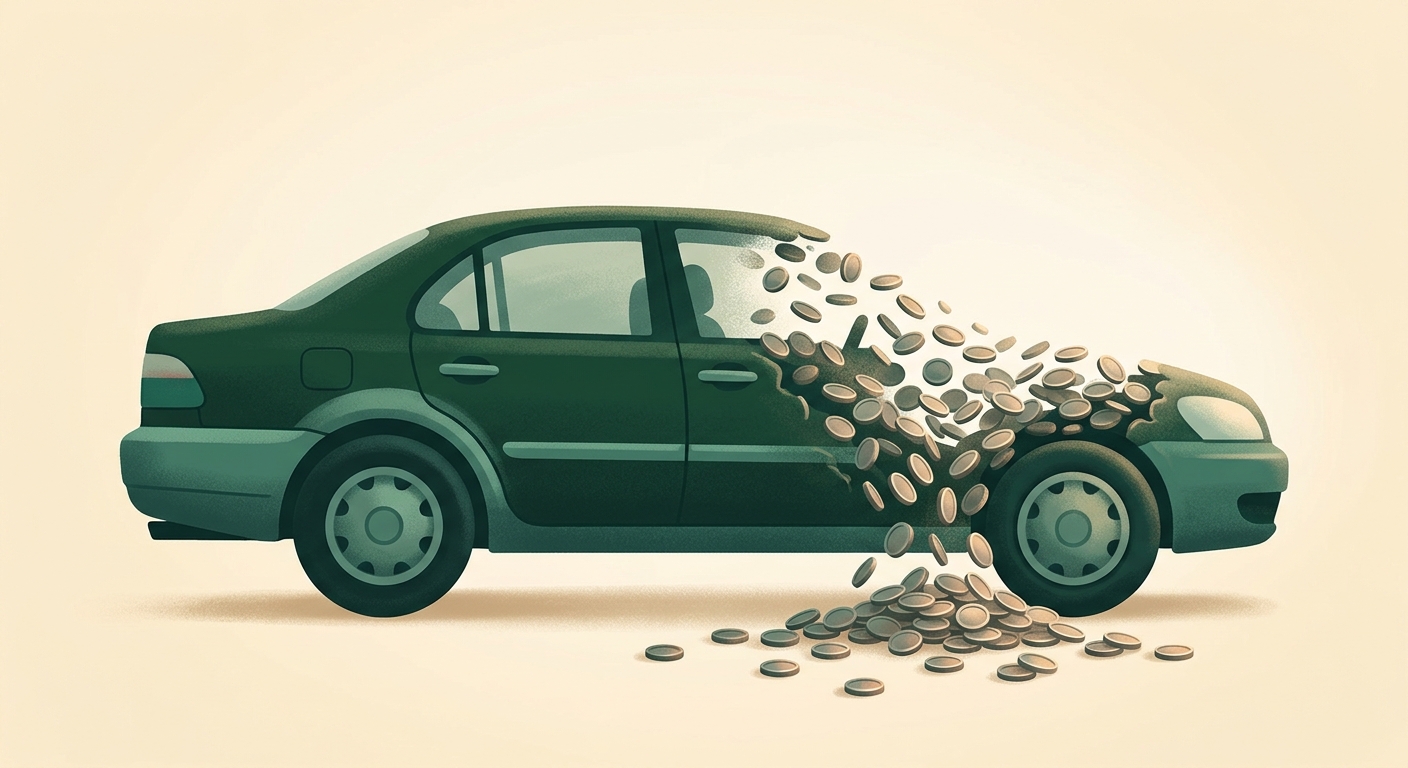
A lease payment looks like rent, but it's built from two very specific pieces: the car's projected depreciation over the lease term, plus a smaller finance fee called a rent charge. There's no principal being paid down and no equity being built — you're paying, in installments, for the exact amount of value the car is expected to lose while it's in your driveway.
Here's a real breakdown, using a $32,000 car on a common 36-month lease structure with a 55% residual value (what the leasing company predicts the car will be worth at lease-end):
That works out to about $462 a month — and 87 cents of every dollar in that payment is simply the car losing value while you drive it. The remaining 13 cents is what the leasing company charges to finance the deal, similar in spirit to loan interest. Nothing about a lease statement spells this out; it just arrives as one number.
How steep is new car depreciation, really?
New car depreciation isn't a straight line — it's front-loaded. The steepest drop happens in year one, then it levels off:
| Year | Value at year-end | Cumulative value lost |
|---|---|---|
| 1 | $25,600 | 20.0% |
| 2 | $22,528 | 29.6% |
| 3 | $19,825 | 38.0% |
| 4 | $17,446 | 45.5% |
| 5 | $15,352 | 52.0% |
By year five, this car has lost just over half its original value — and $6,400 of that, more than a third of the total five-year loss, happened in the first twelve months alone. That single fact is the entire reason a used-car strategy tends to work so well.
Why a used car often wins the depreciation math
If you buy a 2-3-year-old version of that same car instead of a new one, someone else already absorbed the steep year-one drop before you signed anything. You're stepping onto the depreciation curve after its worst year is already over, and from there it only rides the shallower ~12%-a-year decline:
| Year of ownership | Value lost that year | Value at year-end |
|---|---|---|
| 1 | $2,760 | $20,240 |
| 2 | $2,429 | $17,811 |
| 3 | $2,137 | $15,674 |
| 4 | $1,881 | $13,793 |
| 5 | $1,655 | $12,138 |
Lower starting price, lower dollar-amount depreciation every single year, and none of that brutal first-year hit. That's not a used-car-lot sales pitch — it's just what the same depreciation curve looks like once someone else has already ridden its steepest section.
Putting all three paths on the same 5-year clock
To actually compare leasing, buying new, and buying used, they need to be measured the same way, over the same stretch of time. Here's the model this calculator uses:
- Leasing is modeled as paying a monthly lease rate continuously for 5 years (in practice, that usually means re-leasing partway through, since most leases run 36 months) and owning nothing at the end. Two back-to-back 3-year leases costing more than one 5- or 6-year ownership period is a pattern that shows up across independent cost comparisons, not just this one.
- Buying new or used is modeled as a 5-year loan (so it's fully paid off at the end of the comparison window), with the car's depreciated value at year 5 counted as real equity you still hold.
Try it with your own numbers below — every field is editable.
Lease vs. new vs. used: your 5-year cost
Defaults match the worked example below. Assumes a 5-year (60-month) horizon and a loan term matching that horizon, so all three paths compare apples to apples.
| Path | Total paid over 5 years | Value kept at year 5 | Net 5-year cost |
|---|---|---|---|
| Leasing | — | — | — |
| Buying new | — | — | — |
| Buying used | — | — | — |
The worked example, in full
Using the calculator's defaults — a $32,000 new car, a comparable $23,000 used car (2-3 years old), 10% down, and current average auto loan rates for good (not perfect) credit, per Experian's Q2 2026 data (6.23% new, 8.77% used) — here's how the sticker monthly payment compares to what each path actually costs once depreciation is accounted for:
| Path | Monthly payment | Net 5-year cost | Real cost per month |
|---|---|---|---|
| Leasing | $462 | $28,220 | $470 |
| Buying new | $560 | $21,440 | $357 |
| Buying used | $427 | $15,806 | $263 |
That last column is the one that actually matters, and it flips the story most people assume walking in. Leasing's monthly payment looks reasonable next to buying new — but because you keep nothing at the end, its real cost per month is the highest of the three, not the lowest. Buying new has the highest sticker payment of the group, but because you're still holding $15,352 in equity at year five, its real cost drops well below the lease. Buying used wins on every measure that matters: a lower monthly payment and, once its resale value is counted, a real cost less than half of leasing's.
Over the full five years, that's $6,780 saved by buying new instead of leasing, and $12,414 saved by buying used instead of leasing — money the leasing company keeps and you don't, in exchange for a slightly smoother monthly number and the option to walk away every few years.
When leasing still makes sense
None of this makes leasing a mistake in every situation — it just means it should be a deliberate trade, not a default:
- You genuinely want a new car every 2-3 years. If that's true regardless of the math, leasing is the more convenient way to do it — just go in knowing you're paying a premium for that convenience, not getting a deal.
- Predictability matters more than total cost. A lease payment rarely changes and almost always stays under factory warranty, so there's no surprise repair bill risk — a real value to some people, even at a real price.
- The car is a business expense. Self-employed and business use cases can change the math substantially through tax treatment — that's outside what this post covers, and worth a conversation with a tax professional if it applies to you.
- You don't have a down payment saved yet. Leases typically require less upfront cash than a purchase. That's a legitimate short-term reason to lease — just revisit the math once you've built one up.
Already leasing and deciding whether to end it early instead?
This post is about choosing a path from scratch. If you're already in a lease and wondering whether buying it out before the term ends is worth it, that's a different question with its own math — see Should You Buy Out Your Car Lease Early? The Real Math.
Quick answers
Is it cheaper to lease or buy a car?
Over a multi-year horizon, buying is almost always cheaper than leasing, because leasing leaves you with nothing at the end while buying leaves you with an asset still worth something. In the verified example above, buying outright cost $6,780 less than leasing over five years, and buying used cost $12,414 less. Leasing can still win on short-term monthly cash flow — just not on total cost.
Why does a used car depreciate slower than a new one?
A new car takes its steepest drop in year one — commonly around 20% of its value — the moment it stops being "new" in the resale market's eyes. A 2-3-year-old used car has already absorbed that hit before you buy it, so you only ride the shallower decline that follows.
Does buying used ever not win?
It can, if the used car needs financing at a much higher rate than your credit would get on new (some lenders price used loans significantly higher, as reflected in the calculator's default rates), or if a manufacturer incentive drops the new-car price or rate low enough to close the gap. Run your own numbers above rather than assuming the general pattern holds exactly for your specific deal.
Before any of this, it's worth knowing what you can actually afford to put toward a car in the first place — start with our guide to how much car you can actually afford and the 20/4/10 rule breakdown. And if you're leaning toward financing either the new or used path, see how loan term alone changes the math in how 72-month auto loans silently drain your net worth.