 PocketProof
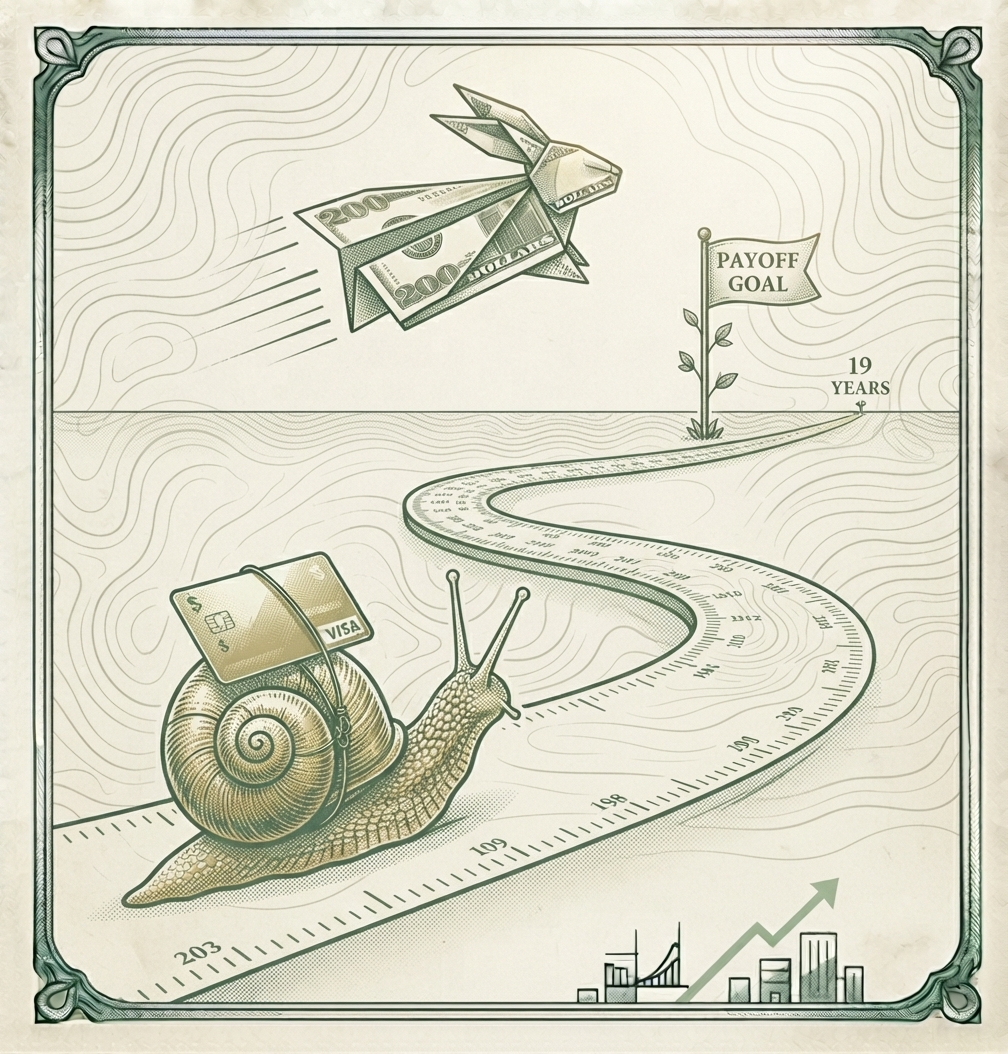
A $5,000 credit card balance at 22.99% APR, paid at exactly the minimum every month, takes roughly 19 years to clear and costs $8,489 in interest, more than the original balance itself. Paying the minimum feels like slow, steady progress. It's closer to a treadmill.
Why the minimum barely moves the balance
Most card issuers calculate your minimum payment as 1% of your balance, plus that month's accrued interest (with a floor, commonly $25). That formula sounds reasonable until you notice what happens as the balance shrinks: the minimum shrinks right along with it. A smaller required payment means less principal gets paid down each month, which means the balance shrinks even more slowly, which shrinks the next minimum payment too. It's a loop that only gets more sluggish over time — not a fixed monthly amount steadily chipping away at a fixed debt.
The formula
Minimum payment = greater of (1% of balance + this month's interest) or a floor amount (commonly $25)
Minimum payment trap calculator
Enter your own balance, APR, and minimum payment structure — the calculator runs the same formula issuers actually use, not a simplified version.
What will minimum payments really cost you?
Defaults match the example below.
Case study: Sarah's $5,000 balance
Sarah carries a $5,000 balance at 22.99% APR, with a minimum payment set at 1% of her balance plus that month's interest, floored at $25.
| Starting balance | Time to pay off | Total interest paid |
|---|---|---|
| $2,000 | 11.8 years | $2,741 |
| $5,000 | 19.3 years | $8,489 |
| $10,000 | 25.1 years | $18,068 |
On minimum payments alone, Sarah's $5,000 balance takes 19.3 years and costs $8,489 in interest — 70% more than the balance she started with. If she instead pays a fixed $200/month — not a huge stretch, just a number that doesn't shrink as the balance does — she clears it in 35 months, under 3 years, for $1,871 in interest. Same starting balance, same APR. The only thing that changed is that her payment stopped shrinking along with the debt.
What actually moves the needle
You don't need to double your payment to escape the trap — any fixed amount that doesn't decline as your balance does breaks the loop, because a fixed payment covers a growing share of principal every single month instead of a shrinking one. If you're deciding how to structure that fixed payment across multiple debts, our debt snowball vs. avalanche comparison covers the order; our realist's payoff plan worksheet covers writing the commitment down so it sticks.
And since the APR is what makes the minimum-payment math this brutal in the first place, a lower rate helps twice — it shrinks the minimum itself and shrinks how much of any payment goes to interest instead of principal. See our credit card APR negotiation script for the exact call.
Want to see the real payoff math for your balance?
The PocketProof Budget System ($15) is an Excel & Google Sheets budget spreadsheet that runs this calculation for you — plug in a balance, rate, and payment, and its debt payoff tracker shows exactly how much a fixed payment saves over the minimum.