 PocketProof
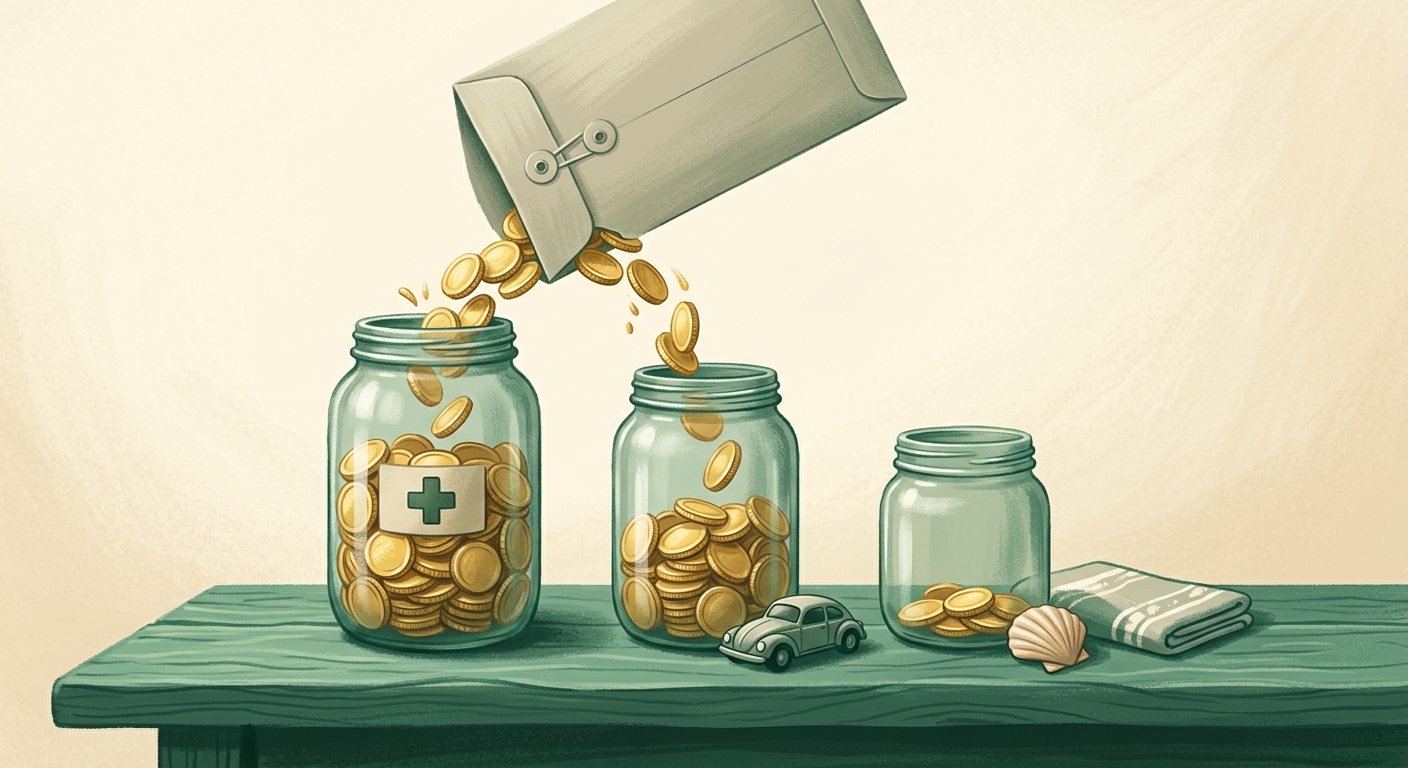
Savings buckets are separate savings accounts (or labeled pots inside one account), each set aside for a single goal and filled by its own automatic transfer. They let you save for a trip, a car repair, and a future apartment at the same time, without any of those goals borrowing from your emergency fund.
The problem they solve is easy to miss. If all your savings sit in one account, a $1,800 vacation and a $1,800 emergency come out of the same pile. After the trip, your balance looks like "savings," but part of your emergency cushion is gone and nothing tells you so. That cushion matters: in the Federal Reserve's 2025 household survey, only 63% of adults said they'd cover a surprise $400 expense with cash or its equivalent.
How I split mine
I use three buckets at Capital One, and money goes into each one automatically every month:
- Emergency Fund: $500 a month. It's the most important one, so it gets most of the money. My goal is $7,000, which is about three months of my expenses.
- Car Fund: $50 a month for maintenance and repairs, so an oil change or new tires never touches the emergency fund.
- Vacation: $100 a month. I can plan a trip and pay for it in cash while the other two keep growing.
Once the emergency fund hits a healthy level, I'll change the split: a bit more into the car fund and a new bucket for something else. The emergency fund comes first, but the other goals don't have to wait until it's done.
Why does one savings account make it so easy to drain your emergency fund?
One account gives you one number, and one number can't tell you what the money is for. Say you have $4,000 saved and book a $1,200 trip. You still have $2,800, so it feels fine. Then your car needs $900 in brakes and tires, and you're down to $1,900. Each decision looked reasonable, but your emergency cushion is now less than half of what it was.
Buckets give each dollar a job before you ever spend it. The trip money is in the vacation bucket. The brakes come out of the car fund. If a bucket comes up short, you see it right away and decide what to do, instead of finding out during an actual emergency.
Buckets are labels, not locks. In a real emergency, you can still pull from the vacation bucket. The difference is that it's a decision you make on purpose, not something that happens without you noticing.
What savings buckets should you set up in your 20s?
Start with the emergency fund, then add buckets for the costs that tend to land on a credit card. Here are the most useful ones, plus a simple way to work out a goal for each:
| Bucket | What it covers | How to set the goal |
|---|---|---|
| Emergency Fund | Job loss, medical bills, anything you can't predict | 3 to 6 months of essential expenses (how to pick your number) |
| Car Fund | Oil changes, tires, brakes, your insurance deductible | Start with your deductible, then keep a steady amount going in |
| Vacation | Flights, lodging, spending money | Trip cost divided by months until you go (trip savings calculator) |
| House Down Payment | Down payment and closing costs | Usually a multi-year goal (how much you really need) |
| Moving / Next Apartment | Security deposit, first month's rent, movers, furniture | Deposit plus first month's rent plus about $500 for the move itself |
| Weddings & Big Events | Travel, gifts, and outfits for friends' weddings and bachelor or bachelorette trips | Number of invites you expect this year times your realistic cost per event |
| Holidays & Gifts | December spending, birthdays | Last year's gift spending divided by 12 |
| Tech Replacement | A new phone or laptop when the old one dies | Replacement price divided by the months you expect it to last |
| Medical / Deductible | Copays, prescriptions, the deductible on your health plan | Your plan's deductible |
| Pet | Vet visits, an unexpected vet bill | Annual checkup cost plus a cushion for one surprise visit |
| Annual Bills | Car registration, renters insurance paid yearly, yearly subscriptions | Total of the yearly bills divided by 12 (sinking funds explained) |
You don't need all eleven. Three or four buckets you actually fund beat ten that each get $5 a month. A good test: if a cost has landed on your credit card in the last year, it probably deserves a bucket.
Which savings bucket should you fill first?
The emergency fund comes first, but "first" doesn't have to mean "only." Here's an order that works for most people in their 20s:
Starter cushion
Get $500 to $1,000 into the emergency fund as fast as you can.
Mostly emergency
Send the bulk to the emergency fund and small amounts to 1 or 2 goals.
Roll it over
Once it's full, move the emergency fund's monthly amount into the other buckets.
Step 1 is covered in our guide to saving your first $1,000 quickly. Step 2 is the split I use: $500 to the emergency fund, $150 spread across the car and vacation buckets. It keeps the most important goal moving fast without putting a planned trip on a credit card.
One exception: if you're carrying credit card debt at 20% or more, paying it down usually comes before any bucket beyond the starter cushion. Our emergency fund vs. debt payoff calculator helps you find the split.
How long will each bucket take to fill?
Using my split as the example, with $0 saved to start: the emergency fund gets $500 a month toward $7,000, so it's full in 14 months. Say the car fund's goal is $1,500 and the vacation goal is $2,000 (example goals, set yours however you like). At $50 and $100 a month, those take 30 months and 20 months.
Now roll the emergency fund's $500 into the other two the month after it fills, split in the same 1-to-2 ratio as before. The vacation bucket finishes in 16 months instead of 20, and the car fund in 17 months instead of 30. Same $650 a month, over a year sooner on the car fund.
Enter your own buckets below. Leave the goal blank for an open-ended bucket (like a car fund you keep filling forever) and the planner treats it as ongoing.
When will each of your buckets be full?
Add up to 5 buckets with a goal, what you've already saved, and what goes in each month. Months count from next month. Interest isn't included.
What should you do when your emergency fund is full?
Keep the total going into savings the same and give the emergency fund's share a new job. The habit is already built and your budget already works without that money, so this is the easiest raise you'll ever give your goals.
For my $650 a month, the next version might look something like this (an example, not a rule):
- Emergency Fund: $0 until it needs refilling
- Car Fund: $150, up from $50
- Vacation: $150, up from $100
- A new bucket: $350, such as a house down payment or a moving fund
Two rules keep this from backfiring:
- Refill before anything else. If you use the emergency fund, send its old $500 back to it until it's full again, then switch back.
- Raise the goal as your life changes. Three months of expenses on your first salary is a smaller number than three months after you move out or get a raise. Check the target once a year.
If you're past the emergency fund and your 401(k) match, some of that freed-up money may belong in investing instead of another bucket. See the investing order of operations for where it fits.
How do you set up savings buckets in Capital One?
Capital One doesn't call them buckets. Instead, you open a separate 360 Performance Savings account for each goal. Capital One says you can create multiple savings accounts, each for a separate goal, with no fees or minimums. Here's the setup:
- Open your first 360 Performance Savings account if you don't have one. Capital One says it takes about 5 minutes online or in the app, with no minimum balance.
- Open one more savings account for each extra bucket. Sign in and open a new 360 Performance Savings account from your existing login. It shows up next to your others, with its own balance.
- Nickname each account by its goal. Rename it from the account's settings to "Emergency Fund," "Car Fund," or "Vacation" so you see goals instead of account numbers.
- Set up an Automatic Savings rule for each bucket. Choose your checking or savings account, scroll down to Automatic Savings, select View Automatic Savings, and pick a rule:
- Recurring transfer: a fixed amount on a schedule (weekly, biweekly, monthly, and so on). Works from a Capital One or an outside checking account.
- Paycheck percentage: a set percentage of each direct deposit. Needs a Capital One checking account and is set up in the mobile app.
- Time it for payday. Schedule each transfer for the day after your paycheck lands, so the money moves before you can spend it. Transfers between Capital One accounts are instant; transfers from another bank take 2 to 3 business days.
Each savings account is a full 360 Performance Savings account, so every bucket earns that account's interest rate. App menus get redesigned now and then, so if a label doesn't match exactly, Capital One's AutoSave page has the current steps.
Not with Capital One?
Plenty of online banks build this in. Ally calls them "buckets" inside one savings account, and SoFi calls them "Vaults." If your bank has neither, open a few separate savings accounts and name them yourself. If your money is in a big-bank savings account earning almost nothing, our high-yield savings guide shows what moving it is worth. And if you'd rather set automation up step by step, the automated savings checklist works with any bank.
What are the most common savings bucket mistakes?
- Too many buckets at once. Ten buckets at $15 each feel organized but fill so slowly that you stop caring. Start with three or four.
- Buckets with no goal amount. "Vacation" with no number never feels done. Give each bucket a goal, even a rough one.
- Paying for planned costs from the emergency fund. Car registration and holiday gifts aren't emergencies. They're why the other buckets exist.
- Keeping buckets in checking. Money that sits next to your debit card gets spent. Keep buckets in savings, ideally high-yield.
- Forgetting to refill. Using a bucket is the point. Just make sure its automatic transfer keeps running afterward.
Common savings bucket questions
How many savings buckets should I have?
Three or four to start: an emergency fund plus the two or three goals you'd otherwise pay for with a credit card. Add more as new goals come up, but if you can't name every bucket from memory, you probably have too many.
Are savings buckets the same as sinking funds?
A sinking fund is one kind of bucket, for a cost you know is coming, like car registration. "Buckets" covers all of your savings, including the emergency fund, which is for costs you can't predict. Our sinking funds guide has a planner for the predictable ones.
Is my money FDIC insured if it's split across several accounts?
Yes. FDIC coverage is $250,000 per depositor, per bank, per ownership category. Several individual savings accounts at the same bank count together toward that one $250,000 limit, which is far more than most people in their 20s have in savings.
What if an emergency costs more than my emergency fund?
Use the other buckets next. A vacation can be pushed back; a missed rent payment is much harder to fix. That's still the system working: the money was there because you saved it, and now you refill in the same order.
Still building the first bucket? Start with how to build an emergency fund when money is tight, then come back and add the fun ones.