 PocketProof
For most people in their 20s, a Roth 401(k) is the better pick, because you're likely in a lower tax bracket now than you'll be later, and Roth lets you pay tax at today's low rate and withdraw everything tax-free in retirement. The exception is if you already earn enough to be in the 24% bracket or higher, where Traditional's upfront tax break is usually worth more.
You probably met this question on a benefits enrollment screen during your first week at a new job, with two checkboxes and about 30 seconds to decide. Lots of people guess, pick whatever HR's default was, or skip it entirely to deal with "later." Here's how to actually decide, with numbers, in about five minutes.
What's the actual difference between Roth and Traditional?
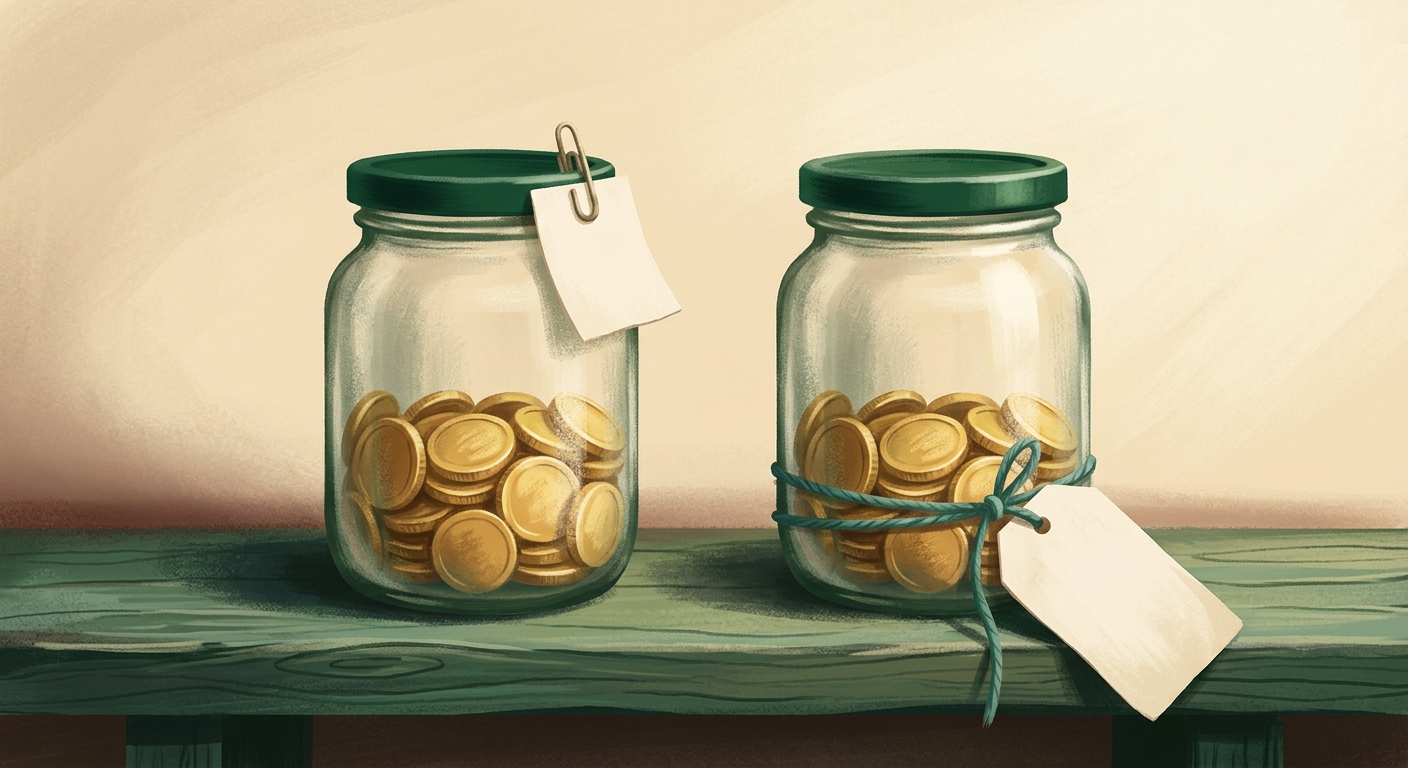
Both are the same 401(k), with the same investment options and the same contribution limit. The only difference is when you pay income tax:
- Traditional (pre-tax): your contribution comes out of your paycheck before income tax, so your tax bill is lower today. In retirement, every dollar you withdraw, contributions and growth, is taxed as income.
- Roth (after-tax): you pay income tax on the money now, like the rest of your paycheck. In retirement, every qualified withdrawal, contributions and growth, is tax-free.
So it's a bet on one thing: will your tax rate be higher now, or when you withdraw? Pay tax at whichever rate is lower.
Why does Roth usually win in your 20s?
Because your 20s are usually the lowest-earning decade of your working life, which means it's often the cheapest time you'll ever have to pay income tax on this money.
In 2026, a single filer gets a $16,100 standard deduction, and the 12% bracket runs up to $50,400 of taxable income. Add those together and a salary up to about $66,500 keeps your top federal rate at 12% (a little higher if you also have pre-tax deductions like health insurance). That covers a lot of first and second jobs.
If your income grows over your career like most people's does, your tax rate in retirement may well end up higher than 12%. Even if it doesn't, you lose very little by locking in 12% now. And the longer the money compounds, the more of your final balance is growth, which Roth never taxes. For someone at 24, that's 40-plus years of growth.
The worked example: same paycheck hit, different tax timing
Someone who's 24, earning $55,000 (taxable income $38,900 after the standard deduction, so a 12% top rate), wants to put $200 a month of take-home pay toward retirement until 65. That's 41 years at an assumed 7% average annual return.
- Roth: $200 a month goes in after tax. It grows to $565,391, and all of it is theirs to withdraw tax-free.
- Traditional: because pre-tax money skips the 12% tax, the same $200 hit to take-home pay lets them contribute $227.27 a month. That grows to a bigger balance, $642,490, but every dollar is taxed on the way out.
What they actually keep from the Traditional account depends entirely on the tax rate in retirement:
| Tax rate on withdrawals | Roth (tax-free) | Traditional (after tax) | Roth ahead by |
|---|---|---|---|
| 10% | $565,391 | $578,241 | −$12,850 (Traditional wins) |
| 12% (same as today) | $565,391 | $565,391 | $0, an exact tie |
| 15% | $565,391 | $546,116 | $19,275 |
| 22% | $565,391 | $501,142 | $64,249 |
| 24% | $565,391 | $488,292 | $77,099 |
Notice the tie at 12%. That's not a coincidence: when your tax rate is the same at both ends, Roth and Traditional give you exactly the same money, down to the dollar. Multiplying by (1 − tax rate) gives the same answer whether you do it at the start or the end. Everything else is just which direction your rate moves.
Now flip it. Someone already in the 22% bracket who puts the same $200 of take-home pay into Traditional can contribute $256.41 a month, which grows to $724,860. If that's taxed at 12% in retirement, they keep $637,877, which is $72,486 more than the Roth. That's the Traditional case: a high rate today and a lower one later.
One honest complication: retirement tax is an average, not a single rate
In retirement, the first chunk of your withdrawals is covered by the standard deduction (taxed at 0%), the next chunk at 10%, then 12%, and so on. So the rate that matters for Traditional is the average rate on what you take out, which is usually lower than your top bracket. That's why Traditional gets more competitive the higher your rate is today, and why 22% is genuinely a close call rather than an automatic Roth.
The decision tree: Roth or Traditional for you?
Answer three questions or fewer. Salary ranges assume a single filer taking the 2026 standard deduction. If you're married filing jointly, roughly double them.
Roth or Traditional?
Not a calculator. This walks through the same questions a fee-only planner would ask about this choice.
First: are you contributing at least enough to get your full employer match?
Roughly what's your yearly salary?
Would choosing Roth (a slightly smaller paycheck for the same contribution) make you cut back on how much you save?
Do you expect your income to keep rising a lot (early career, finishing a degree or certification, fast-growing field)?
A 50% or 100% match is an instant return on that money. The biggest Roth vs. Traditional gap in the table above is about 14% of the final balance, built up over 41 years. Raise your contribution to whatever percentage unlocks the full match, in either account type, then come back to this question. Our investing order of operations shows where the match fits.
At 12%, going Roth costs you $12 in federal tax for every $100 of salary you route into it. The upside: if your rate in retirement is 22%, you come out $64,249 ahead on $200 a month over 41 years, and if it's the same 12%, you tie. The only scenario where you lose is retiring at a lower rate than 12%, and even then the gap is small ($12,850 at 10%).
Traditional lowers your tax bill today, so the same hit to take-home pay puts more into the account. If Roth would make you drop from 6% to 4%, the Traditional at 6% is the better choice. You can switch to Roth later with a few clicks once money loosens up. Your plan lets you change your election at any time.
If you expect to move into the 24% bracket or higher, paying 22% now is a reasonable trade. A middle ground: put most of your contribution into Roth and some into Traditional. You're not locked in either way. You can rebalance the split every year as your income changes.
At 22% today, nobody can tell you for sure whether your average rate in retirement will be higher or lower, because it depends on future tax law and your future income. Splitting gives you two buckets in retirement: a taxable one to draw from in low-income years and a tax-free one for the rest. That flexibility is worth something on its own.
At 24%, every $200 you contribute pre-tax saves $48 in federal tax this year. Unless you're confident your income will keep climbing well beyond where it is now, Traditional is usually the better default. Consider a Roth IRA on the side for tax diversification. For 2026, single filers can contribute to one fully below $153,000 of income, with the ability phasing out completely at $168,000. The Roth 401(k) has no income limit at all.
What are the 2026 contribution limits?
Per the IRS's 2026 cost-of-living adjustments:
- 401(k), Roth and Traditional combined: $24,500 for 2026. It's one shared limit, so splitting between the two doesn't double it. Employer match doesn't count toward it.
- IRA, Roth and Traditional combined: $7,500 for 2026, separate from (and on top of) the 401(k) limit.
- Roth IRA income phase-out: $153,000 to $168,000 for single filers, $242,000 to $252,000 for married couples filing jointly.
- Roth 401(k) income limit: none.
For perspective, $200 a month is $2,400 a year, under 10% of the 401(k) limit. You don't need to be anywhere near the max for this choice to matter. The table above is built on $200 a month.
What about the employer match?
Most plans deposit the match as Traditional (pre-tax) money, even if all of your own contributions go to Roth. That's actually a nice default for a Roth-heavy 20-something: it gives you some tax diversification automatically. SECURE 2.0 now lets plans offer the match as Roth instead, but not every plan does, and if yours does, a Roth match counts as taxable income to you the year it's deposited.
A Roth perk worth knowing if you're also building savings
With a Roth IRA, the money you contributed (not the growth) can be withdrawn at any time, tax- and penalty-free. That's not a reason to treat it as your emergency fund. Keep that in a high-yield savings account. But it does mean money in a Roth IRA isn't as locked away as a lot of people in their 20s fear. Roth 401(k) withdrawals before 59½ follow stricter rules, so check your plan before counting on this there.
Quick answers
Should I choose Roth or Traditional 401(k) in my 20s?
In the 12% bracket or lower (roughly under $66,500 in salary for a single filer in 2026), usually Roth. At 22%, it's close, and splitting is reasonable. At 24% and up, usually Traditional, unless you expect your income to keep climbing a lot.
Can I contribute to both a Roth and a Traditional 401(k)?
Yes, if your plan offers both. You can split each paycheck between them. The $24,500 limit for 2026 is combined, not $24,500 each.
Is my employer match Roth or Traditional?
Usually Traditional, even if your own contributions are Roth. Some plans now offer a Roth match under SECURE 2.0; it's taxable income to you the year it's deposited.
Is there an income limit for a Roth 401(k)?
No. The Roth IRA has one: for 2026, contributions phase out between $153,000 and $168,000 for single filers ($242,000 to $252,000 married filing jointly). The Roth 401(k) has no income limit.
Still figuring out where retirement fits next to debt and savings? Start with how to start investing when you know nothing about it, then check the fees on whatever fund you pick inside the account with our expense ratio calculator. A Roth with a 1% fund can quietly give back everything the tax choice won you.