 PocketProof
The biggest investing mistake is waiting until you feel ready. For most people, that quietly turns into never starting. A verified example later in this post shows exactly what a 10-year delay costs on the same $50/month: $34,952 at retirement, gone, without a single bad investment being involved.
Why "I don't know enough yet" is the wrong reason to wait
You don't need to understand the market to start responsibly — you need a diversified, low-cost fund and consistency, and both of those remove almost all of the "expertise" the fear is actually about. The people who do best with investing over the long run usually started early, kept contributing on autopilot, and didn't touch it during scary headlines. That's a temperament question, not a knowledge question.
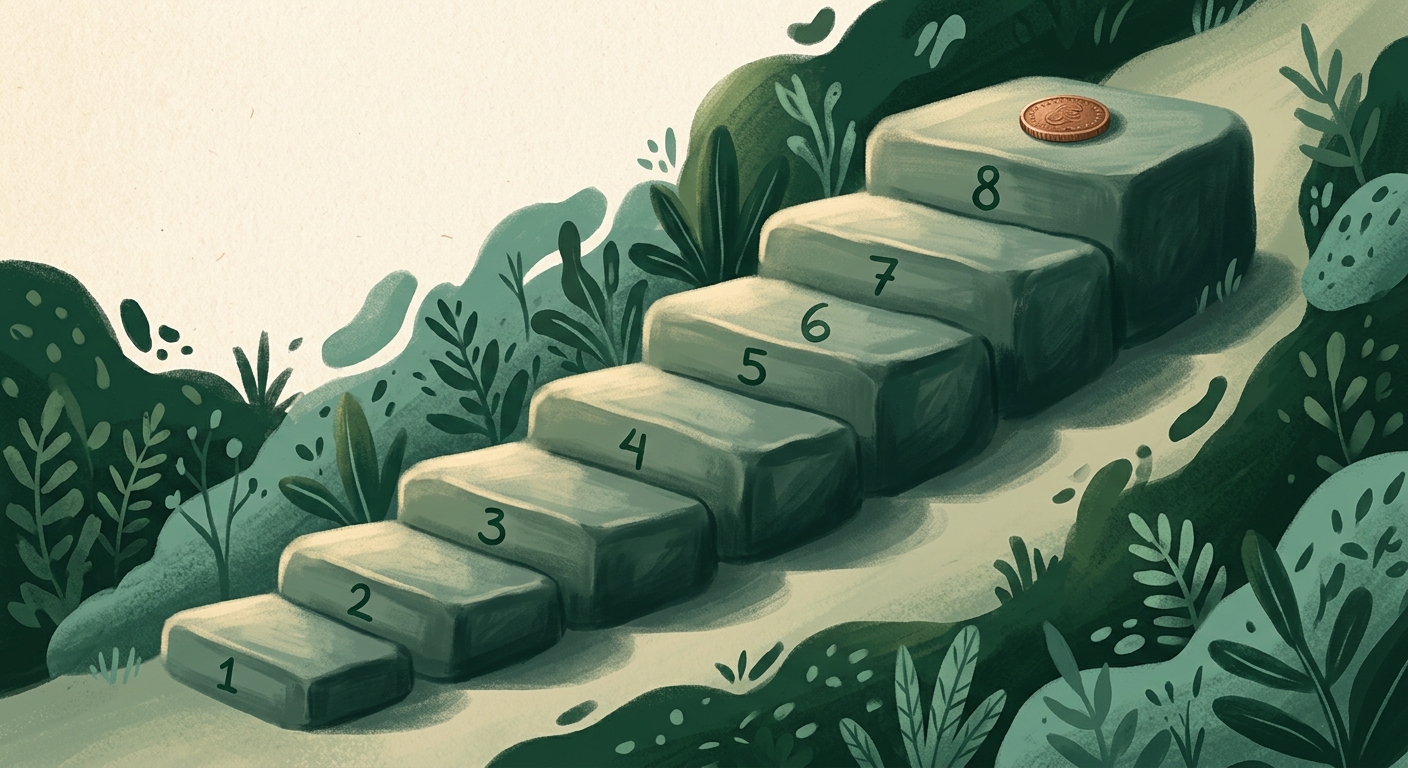
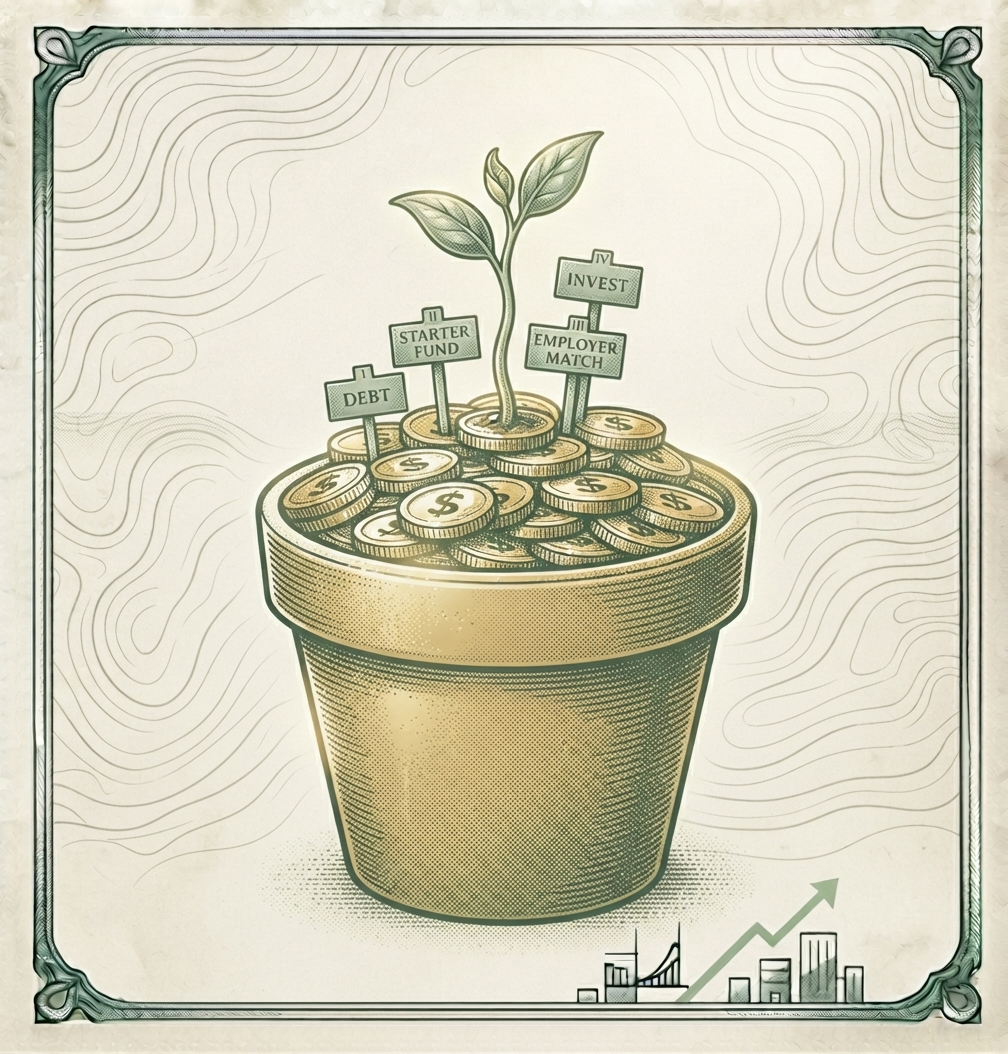
The order that actually matters before you invest a dollar
- Pay off high-interest debt first. A 24% APR credit card is a guaranteed 24% "return" on paying it down — no investment reliably beats that. See the true cost of minimum payments if that debt is still open.
- Build a small starter emergency fund. $500–$1,000 before investing anything extra, so a flat tire doesn't force you to sell investments at a bad time. Our emergency fund guide covers exactly this stage.
- Grab any employer 401(k) match, in full, before anything else. If your employer matches contributions, that's an immediate, guaranteed return no other step on this list can compete with — leaving it unclaimed is the closest thing to free money you'll ever pass up. Here's how a 401(k) match works and how to get the full amount. If your plan asks you to choose Roth or Traditional, our Roth vs. Traditional 401(k) decision tree walks through it.
- Then, and only then, open an account and start small. $25 or $50 a month is a completely legitimate place to begin — the amount matters far less than starting the habit now instead of waiting for a bigger one later.
The 3 things you actually need to understand
1. Compound growth
Your investment returns start earning their own returns. A small amount left alone for decades can end up worth several times what you actually put in — not from adding more money, but purely from time. This is the entire reason starting early matters more than starting big.
2. Index funds vs. picking individual stocks
An index fund holds a small slice of hundreds or thousands of companies at once, so no single company's bad year can sink you — and you're not trying to out-guess professional traders with more time and data than you have. For a beginner with no interest in researching individual companies, a low-cost, broadly diversified index fund is the standard, unglamorous, well-supported starting point. The "low-cost" part matters more than it sounds — see what an expense ratio actually costs you for how a 1% fee versus a 0.05% one adds up to six figures over a career.
3. Your own time horizon
Money you'll need within the next few years — a house down payment next year, a wedding next summer — doesn't belong in the market, where a bad-timed dip could force you to sell at a loss. Money you won't touch for a decade or more has time to ride out the market's normal ups and downs. Know which kind of money you're working with before you decide where it goes.
What could your money actually grow into?
Enter your own numbers — this runs the same math as the case study below, using standard monthly compounding.
Investment growth calculator
Defaults match the example below: starting from $0, $50/month, a 7% average annual return, over 30 years.
A hypothetical, not a promise — real markets don't move in a straight line, and past averages don't guarantee future returns. This assumes a constant rate for simplicity.
Case study: what a 10-year delay actually costs
Maria starts investing $50/month at age 25, into a low-cost index fund averaging 7% a year, and never touches it until retirement at 55 — 30 years.
| Scenario | Years invested | Total contributed | Final value |
|---|---|---|---|
| Maria starts at 25 | 30 | $18,000 | $60,999 |
| Same plan, starting at 35 | 20 | $12,000 | $26,046 |
Same $50/month, same 7% assumption, same eventual retirement age — the only difference is a 10-year delay. That delay costs $34,952 at the finish line, more than double what the extra 10 years of $50 contributions alone would explain ($6,000). Most of that gap is compounding that never had time to happen. This is the actual argument for starting now with a small amount instead of waiting for a bigger one later.
Beginner-friendly platforms, compared
Any of these let you open an account and start with a small, automatic monthly contribution. Fees and minimums change over time — confirm current terms before opening an account.
| Platform | Best for | Typical fees | Good if you... |
|---|---|---|---|
| Fidelity | DIY investing with support available | No account minimum; $0 stock/ETF trades | Want to pick your own low-cost index funds but like having phone support as a backup |
| Vanguard | Classic low-cost index investing | No account minimum; $0 stock/ETF trades | Already know you want simple, broad index funds and don't need extra features |
| Charles Schwab | All-around DIY brokerage | No account minimum; $0 stock/ETF trades | Want fractional shares and a full-featured app alongside index investing |
| Betterment (robo-advisor) | Fully automated, hands-off investing | ~0.25%/year management fee | Don't want to choose any individual funds yourself — it builds and rebalances a portfolio for you |
| Acorns | Passive micro-investing from spare change | Flat monthly fee (can be high relative to a very small balance) | Want the lowest-effort possible start — but check the flat fee doesn't eat a large share of small balances |
What mine actually looks like
My setup is a mix, honestly: 401k contributions through work, a standing weekly auto-invest into Acorns, and Robinhood for when I have extra cash or see something worth acting on. Last year the market dropped hard and I put about $600 into a Vanguard S&P 500 ETF. It dropped further, so I added another $1,000. It eventually recovered and I was up about 40% on that money. I'm not saying that to brag or to suggest timing the market is a strategy. It isn't, and I got a little lucky on timing. I'm saying it because I still don't have this fully figured out, and investing while not having it fully figured out is normal, not a prerequisite you're missing.
Common beginner mistakes worth avoiding
- Trying to pick winning stocks before you've started at all. A broad index fund removes the pressure to be right about any single company.
- Checking the balance daily. Short-term swings are normal and mean nothing about a 30-year plan — checking constantly just invites panic-selling at exactly the wrong moment.
- Not automating contributions. A transfer that depends on remembering and feeling motivated every month is a transfer that eventually stops happening.
- Investing money you'll need within a few years. That money belongs in a high-yield savings account, not the market — see your own time horizon above.
Once you're contributing regularly, make it a real line item in your monthly plan using zero-based budgeting — an investment contribution that only happens with "leftover" money is the same failure mode that derails every other financial goal on this site.