 PocketProof
Every "how to save for a big purchase" guide tells you to divide the price by the number of months you have. That math is correct, but it's incomplete — it tells you what you'd need to save, not what you can actually afford to save without squeezing rent, debt payments, or your other goals. The number that actually matters is whichever is lower: the price-divided-by-months number, or a safe share of what's genuinely left over in your budget each month.
Why "divide the price by the months" isn't the whole answer
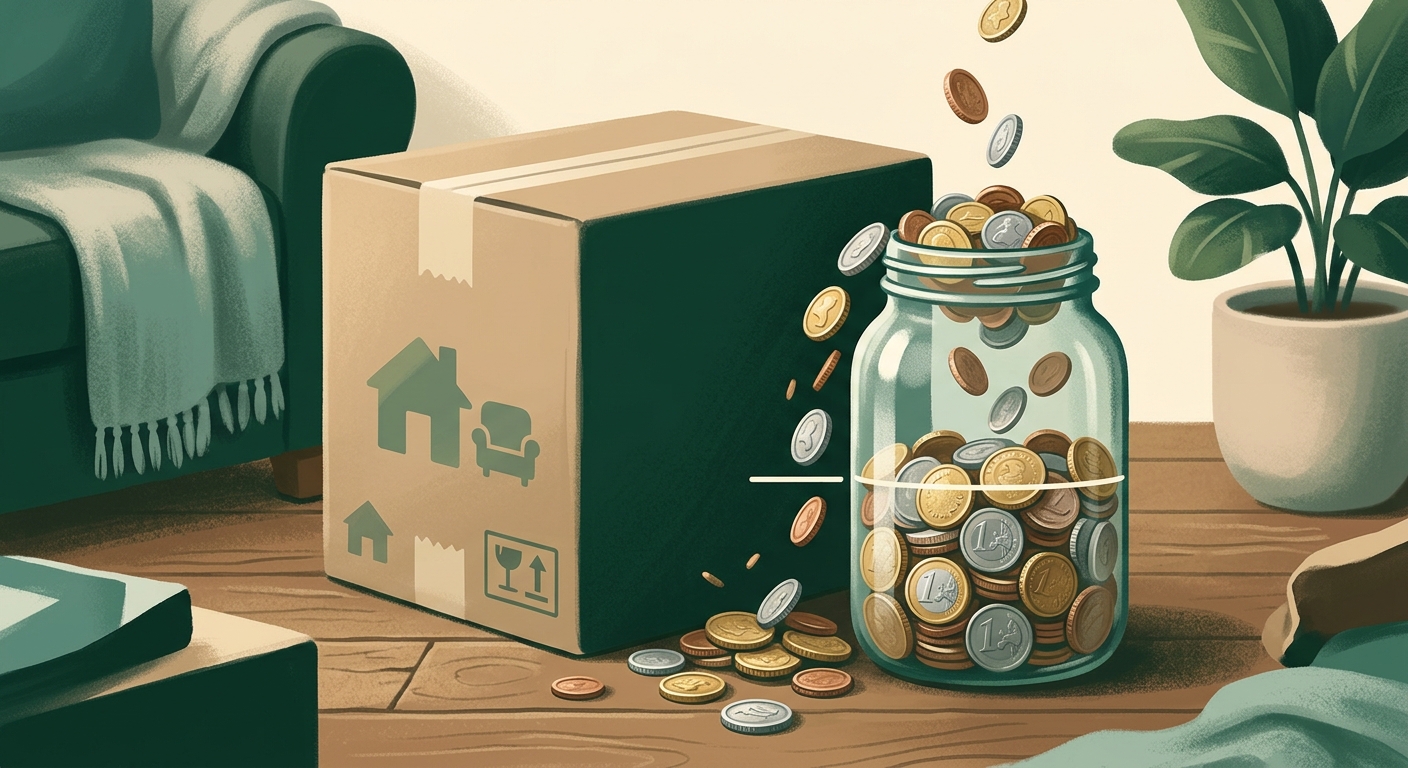
Say you want $4,500 for a first-apartment move — security deposit, first month's rent, a moving truck, and basic furniture — and you've given yourself 6 months to get there. Divide it out and you get $750 a month. That number is mathematically correct and, on its own, tells you nothing about whether it's safe.
If your actual leftover cash flow — what's left after rent, debt payments, groceries, and everything else already spoken for — is $700 a month, that $750 target isn't just tight. It's not physically possible without cutting into money that's already committed elsewhere. And even at a smaller gap, say $500 leftover against a $400 target, spending 80% of your entire cash cushion on one goal leaves nothing for the unpredictable stuff — a car repair, a higher grocery month, a friend's wedding — that shows up whether or not you planned for it.
What counts as your "leftover cash flow"?
This is the number the whole calculation depends on, so it's worth being precise: leftover cash flow is what remains after every fixed bill, every debt minimum, and every savings goal you're already committed to — not your full paycheck, and not even your paycheck minus rent alone.
If you've built a zero-based budget, you already have this number; it's whatever's left once every dollar has a job. If you haven't, a faster gut-check is to look at where your fixed and variable expenses actually land and see what's genuinely unclaimed at the end of the month. Either way, use a real number here, not an optimistic guess — the whole point of the safety cap below is that it only works if the input it's checking against is honest.
The calculator: a safe monthly amount for any big purchase
Enter your goal, your timeline, your real leftover cash flow, and how much of that leftover you're willing to commit to this one goal. The calculator checks the naive number against your safe cap and tells you which one to actually use.
How much can you safely save toward this goal?
Defaults match the worked example below.
The worked example, in full
Using the calculator's defaults — a $4,500 first-apartment fund, 6 months, $700 in real leftover cash flow, and a 40% safety cap — here's what the two numbers look like side by side:
The $750 target isn't just aggressive — at $700 in total leftover cash flow, it's larger than the entire cushion, before a single other goal or surprise expense gets a dollar. The safe number, $280 a month, is what's actually left to give this goal once the 40% cap protects the rest of the budget. Stretched out at that pace, the same $4,500 goal takes 17 months instead of 6 — a big gap on paper, but a plan that doesn't require ignoring every other bill to hit it.
The calculator works the other direction too: plug in a smaller goal or a longer timeline, and the naive number often already fits comfortably under the safe cap — in which case the verdict is simply "on track," and there's nothing to adjust.
What actually happens if you ignore the cap?
Committing to a monthly number your cash flow can't support doesn't usually fail loudly on day one — it fails quietly, a few months in, in one of a few predictable ways: a credit card covers the gap between what you committed to save and what your budget could spare, which is exactly the situation the true cost of minimum payments is built to warn against; the "extra" savings quietly gets pulled from money that was supposed to be an emergency fund, leaving both goals underfunded at once; or the goal just gets abandoned around month three or four, after the mismatch between the plan and reality becomes impossible to ignore.
None of that means the goal itself was unrealistic — it usually means the timeline was, and nobody checked before committing to it.
Closing the gap without giving up on the goal
If the safe number gives you a timeline longer than you wanted, there are exactly three honest ways to close that gap — and "commit to the unsafe number anyway" isn't one of them:
- Extend the deadline. The least disruptive option, and often the right one — 17 months instead of 6 is still progress, without touching anything else in the budget.
- Free up more leftover cash flow first. A few real dollars found in recurring monthly expenses or from a short-term side hustle raises the leftover number the cap is based on, which raises the safe amount without raising the risk.
- Shrink the goal itself. A less expensive version, a sale, secondhand furniture instead of new, or splitting the purchase into phases (the essentials now, the rest later) can bring the price down to something the safe number actually reaches in the time you have.
Saving toward more than one goal at once?
The safety cap above assumes this is one goal competing for your leftover cash flow — but most people are juggling several at a time (a car repair fund, a trip, a gift). See the "sinking funds" method for how to split one leftover-cash-flow number across several named goals at once, instead of recalculating a safety cap for each one separately.
Quick answers
How much should I save each month for a big purchase?
Start by dividing the total cost by the number of months until you need it — that's your baseline. Then check it against a safety cap of 30-50% of your monthly leftover cash flow. If the baseline is higher than the cap, use the capped amount and accept a longer timeline instead.
What counts as "leftover cash flow"?
Whatever's left in your paycheck after every fixed bill, every debt minimum, and every savings goal you're already committed to — not your full take-home pay. A zero-based budget hands you this number directly.
What if the safe amount isn't enough to reach my goal in time?
Push the deadline out, free up more leftover cash flow first by cutting an expense or adding short-term income, or shrink the goal itself. Committing to an unsafe number and hoping it works out isn't a real fourth option — it's usually how a savings goal turns into a missed bill or new debt.
If the "big purchase" in question is a car specifically, start with how much car you can actually afford before running this calculator — it'll give you a more accurate goal amount to plug in here. And if the honest timeline still feels too slow, the same fast-sprint thinking behind saving your first $1,000 emergency fund quickly applies here too: a short, focused burst toward one number, without pretending it doesn't compete with everything else in your budget.