 PocketProof
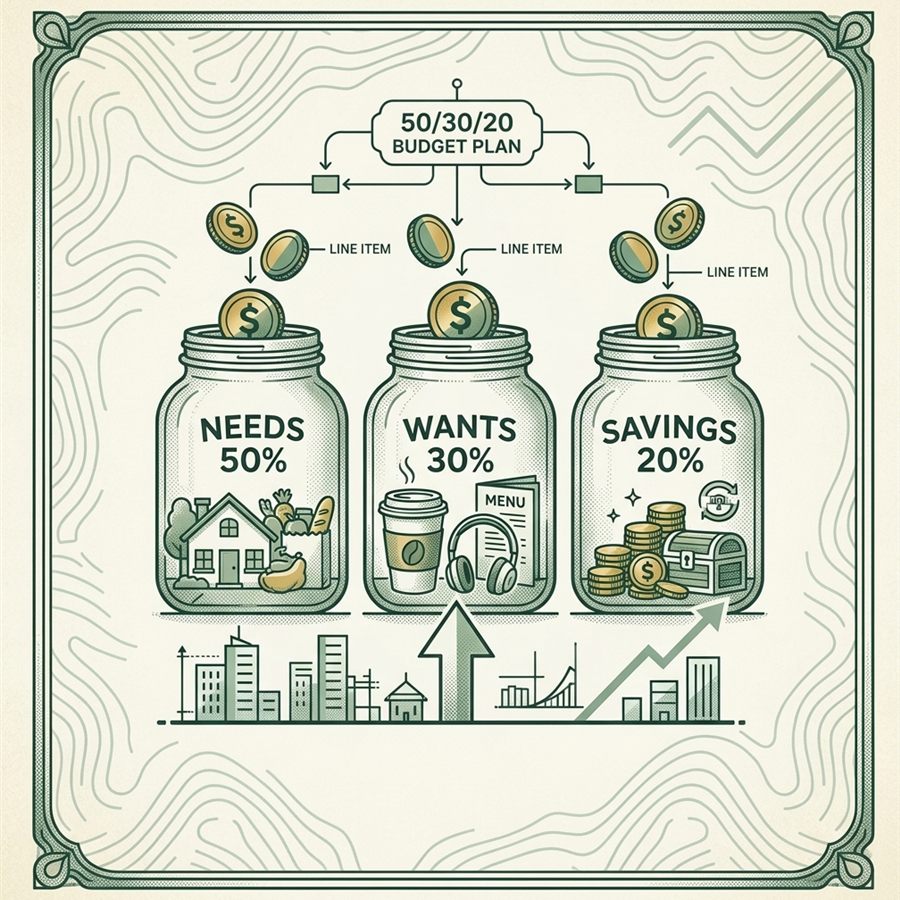
If zero-based budgeting sounds like more categories than you want to manage, the 50/30/20 rule is the simpler alternative. Instead of tracking a dozen line items, you split your take-home pay into three buckets: needs, wants, and savings/debt payoff. That's it.
The three buckets
- 50% — Needs. Rent or mortgage, utilities, groceries, insurance, minimum debt payments, transportation to work. Things you'd still pay if money got tight.
- 30% — Wants. Dining out, streaming services, hobbies, travel, upgraded versions of things you already have. Enjoyable, but not essential. A slice of this bucket works well as genuinely guilt-free spending money. See our fun money allowance guide for sizing that specifically.
- 20% — Savings & extra debt payoff. Emergency fund contributions, retirement savings, and any debt payments beyond the minimum.
What it looks like with real numbers
Take-home pay: $4,000/month.
- Needs (50%): $2,000 — rent, utilities, groceries, insurance, minimum payments
- Wants (30%): $1,200 — dining out, subscriptions, hobbies, discretionary shopping
- Savings & debt (20%): $800 — emergency fund, retirement, extra loan payments
Inside each bucket, you have full flexibility. If you'd rather spend $1,000 on wants and $1,400 on needs some month, the rule doesn't care. It only asks that the three totals land near 50/30/20 overall.
Where this rule tends to break down
- High cost-of-living areas. If rent alone eats 45% of your income, needs will run higher than 50%. That's a real constraint, and it doesn't mean you failed. Scale the remaining share proportionally rather than guessing: at 65% needs, that works out to roughly 65/21/14 rather than an even 65/15/20. See the table below, or the calculator for your own number.
- Variable income. Base your percentages on a conservative average, not your best month. Or better, use our dedicated framework for budgeting on an irregular income, which handles this case directly instead of averaging around it.
- "Needs" creep. A $200/month car payment on a car you didn't need to finance is a want with a loan attached. Be honest when categorizing, or the rule stops meaning anything.
- Wants bucket overflow. If "wants" blows past 30% every month regardless of how carefully you plan it, the fix usually isn't in the budget itself. See our guide on behavioral friction budgeting for how to add real resistance at the point of purchase, not just a bigger number on paper.
50/30/20 vs. zero-based budgeting
These solve different problems. The 50/30/20 rule is a fast way to check whether your overall spending shape is healthy. Zero-based budgeting is a more detailed plan for exactly where each dollar goes. A lot of people start with 50/30/20 to get oriented, then move to zero-based budgeting once they want more control over specific categories like groceries or dining out. For a full side-by-side breakdown, see our zero-based budgeting vs. 50/30/20 comparison, or take our budget style quiz to match your actual habits to a system instead of guessing. See our full worked budget on a $50,000 salary for real numbers instead of percentages.
How to start this week
Pull your take-home pay for last month and sort your actual spending into the three buckets using your bank or card statement. Don't judge the results yet. Just see where you actually land. In practice, plenty of first-time budgets land needs-heavy, some closer to 60/25/15 than 50/30/20. That gap is exactly what tells you where to adjust first: usually by trimming "wants" a little and redirecting it to the savings bucket, a few percentage points at a time.
If your needs bucket is the one running high, our guide on cutting monthly expenses focuses specifically on trimming fixed and near-fixed costs. And if the savings bucket itself is really several different goals mixed together, see our guide on sorting financial goals into needs, wants, and somedays for how to fund each one on purpose instead of by whatever's left over.
This is basically how I set mine up
When I started my current job, I did this exact exercise. I worked out my 50/30/20 split, used the needs number to figure out what rent I could actually afford, and set the savings piece to auto-invest weekly through Acorns so I'd never have to remember to move it manually. I don't keep a running budget spreadsheet day to day. The split did the real work up front; the rest has mostly been staying inside lanes I already set.
When needs run above 50%
Instead of guessing at an adjusted split, scale the remaining share proportionally so wants and savings keep the same 3:2 relationship they have at a standard 50/30/20:
| Needs share | Needs $ | Wants | Savings |
|---|---|---|---|
| 45% | $1,800 | 33% · $1,320 | 22% · $880 |
| 55% | $2,200 | 27% · $1,080 | 18% · $720 |
| 65% (the example above) | $2,600 | 21% · $840 | 14% · $560 |
Try it with your own numbers
See your own three-bucket split, and the adjusted version if your needs run above 50%.
50/30/20 split calculator
Defaults match the example above.
Estimates only. This tool just applies the 50/30/20 math to the numbers you enter.
Want this on paper?
The Printable Monthly Budget Planner in the PocketProof Etsy shop ($7) turns this system into a print-at-home workbook: monthly overview, weekly expense tracker, debt payoff log, and savings goal tracker in one PDF.