 PocketProof
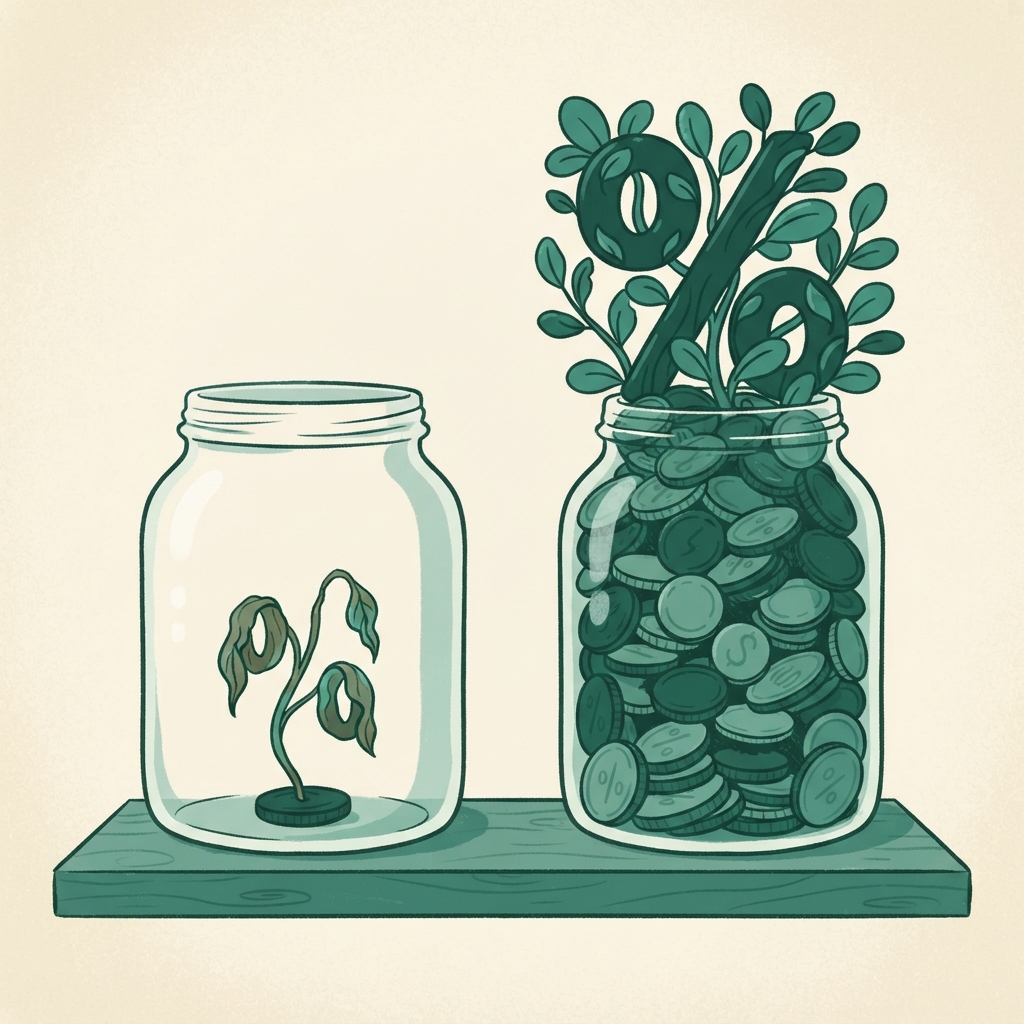
If your savings sits at the same big bank as your checking account, it's probably earning close to nothing. Many major banks still pay 0.01% APY, a rate so low it barely shows up as a rounding error. Move that same money to a high-yield savings account paying 4.50% APY, and $5,000 plus a modest $150/month grows $2,326 more over five years, with the same money, the same safety and the same FDIC insurance. The only thing that changed is which bank is holding it.
What actually makes an account "high-yield"
There's no official certification — "high-yield" just means the APY is meaningfully above the national average for savings accounts (which, per FDIC data, has hovered near 0.4%–0.6% for years, dragged down by big banks paying far less). Most high-yield accounts come from online-only banks, which is exactly why they can afford the higher rate: no branch network, no tellers, no marble lobbies to pay for. They pass that overhead savings directly to you as interest instead.
APY vs. APR — the number that actually matters here
APY (Annual Percentage Yield) already includes the effect of compounding — it's the real, all-in return you'll earn on a deposit account over a year. APR (Annual Percentage Rate) is the number stamped on loans and credit cards instead, and it does not include compounding. When you're comparing savings accounts, always compare APY to APY — a bank quoting a lower-sounding "rate" instead of APY is worth a second look.
Is my money actually safe in one?
Yes — a high-yield savings account is not a riskier place to keep money, just a better-paying one. Legitimate HYSAs are FDIC-insured (or NCUA-insured for credit unions) up to $250,000 per depositor, per bank — the identical protection your money already has sitting in a big-bank savings account. Many online banks offering the best rates are simply divisions of, or partnered with, FDIC-member banks you've never had a reason to notice. Before opening one, just confirm the FDIC (or NCUA) badge is real — search the bank name in the FDIC's BankFind tool if you want to double-check.
What a low rate is actually costing you
Enter your own balance and monthly contribution to see the real dollar gap between where your money sits now and a competitive HYSA rate.
Big-bank rate vs. high-yield rate calculator
Defaults match the case study below.
Case study: Maria's $5,000, three ways
Maria has $5,000 sitting in savings and can add $150 a month. She wants to know what actually changes if she moves it from her big bank's 0.01% APY account to an online bank paying 4.50% APY — same money, same monthly habit, nothing else different.
| Time period | Interest at 0.01% APY (big bank) | Interest at 4.50% APY (HYSA) | Extra interest from switching |
|---|---|---|---|
| 1 year | $0.58 | $267.29 | $266.71 |
| 3 years | $2.29 | $1,091.15 | $1,088.86 |
| 5 years | $4.71 | $2,330.81 | $2,326.10 |
Over 5 years, Maria's big-bank account earns her a total of $4.71 in interest — less than a coffee. The same deposits in a 4.50% APY account earn $2,330.81. Nothing about her behavior changed; she didn't save more or take on any risk. She just stopped letting her bank keep the difference. Even a lump sum sitting untouched shows the same gap fast: $10,000 parked for one year earns about $459 more at 4.50% APY than at 0.01% APY, with zero monthly contributions at all.
Why I'm telling you this so directly
I opened my first savings account with help from my mom, at the same big bank as everything else — completely normal, completely reasonable at the time. What I didn't understand for years afterward was that "a savings account" and "a savings account that's actually earning anything" are two different products, and nobody hands you that distinction automatically. I eventually switched to a high-yield account and the difference wasn't dramatic day to day, but looking back at the interest I left on the table for all those years earlier, it adds up to a real number. I ignored that exact gap for longer than I should have.
When a HYSA isn't the right place for the money
- Money you need within a few days — your everyday checking account (or a linked savings account at the same bank) is still more convenient for money you're actively spending; most HYSA transfers take 1–3 business days to land.
- Money you won't touch for 5+ years — a HYSA is for safety and liquidity, not long-term growth. Historically, diversified investing has outpaced even a strong savings rate over long horizons, at the cost of short-term ups and downs a HYSA doesn't have. See our guide to investing when you know nothing about it for where that line usually sits, or our full decision tree for matching any pile of savings to its timeline if you're not sure which bucket a specific goal falls into.
- Expecting the rate to stay fixed forever — HYSA rates are variable and move with the broader interest-rate environment. The account that's paying 4.50% today isn't contractually promising that rate next year. Check it periodically; it's normal, and often worthwhile, to move banks again if a competitor pulls meaningfully ahead.
What to actually check before opening one
The headline APY grabs attention, but a few other details determine whether you actually keep that rate:
- No monthly maintenance fee. A $5–$15 fee can quietly erase a normal month's interest on a smaller balance.
- No minimum balance required to earn the top rate. Some accounts advertise a rate that only applies above a threshold — read the fine print.
- Free transfers to your existing bank. You'll be moving money in and out around this account; fees or long holds defeat the point.
- It's the ongoing rate, not just a promo. Some banks lure new customers with a temporary bonus rate that drops after 3–6 months — compare the standard rate you'll actually keep earning.
- FDIC or NCUA insured. Non-negotiable — verify it before depositing a cent.
If you're just starting to build a cushion rather than deciding where to park an existing balance, our guide to building an emergency fund on a tight budget walks through the staged approach — this is exactly the type of account that guide recommends keeping it in. And if freeing up the $150/month to actually contribute is the harder part, our 10 practical ways to cut monthly expenses is a good place to find it.