 PocketProof
Most "no-spend month" advice boils down to "just don't spend money," which is exactly why most attempts don't make it past the second week — it's a mood, not a plan. A no-spend month works the same way the rest of this site's tools do: define the boundary precisely, decide the exceptions in advance, and track it somewhere real instead of trusting yourself to remember. Here's a version built to actually survive a full month.
What counts as "no-spend" (and what doesn't)
A no-spend month isn't a spending freeze on your entire life — bills still get paid and groceries still happen. The point is pausing discretionary spending specifically, and the biggest reason people quit is never having a clear line for what's actually paused.
| Stays on (not part of the challenge) | Paused for the month |
|---|---|
| Rent/mortgage & utility bills | Dining out & takeout |
| Groceries & household basics | Non-essential online shopping |
| Gas, transit, and commuting costs | New subscriptions or upgrades |
| Minimum debt payments | Impulse "treat yourself" purchases |
| Medical costs & prescriptions | Entertainment outings (movies, concerts, etc.) |
If a purchase is already a fixed line in your budget, it's not what this challenge is targeting — the goal is the spending that happens without a decision behind it, not your rent.
The week-two wall (why most attempts actually fail)
The most common failure point isn't day one — it's somewhere around day 10 to 15, when an unplanned event shows up: a friend's birthday dinner, a coworker's going-away lunch, something breaks. If the plan was "zero exceptions, no matter what," the first real conflict turns into an all-or-nothing moment — one dinner out and the whole month suddenly feels like it "failed," so people just stop tracking altogether.
The fix is deciding your exceptions before the month starts, not in the moment. Pick one or two things you already know are coming — a birthday, a trip, a standing plan — and budget them on purpose. A planned exception is a decision; an unplanned one is usually just decision fatigue winning, which is the same structural problem our behavioral friction budgeting guide covers for everyday spending.
What a no-spend month could actually save you
Skip the generic "you could save thousands" claim — here's what it actually comes out to using your own numbers. Enter what you'd normally spend on dining out and other non-essentials in an average week, and see the real total for a 30-day challenge, plus what it adds up to if you run this once a quarter instead of once.
No-spend month savings calculator
Estimate your normal weekly spending in these two categories — most people are close within a week or two of guessing.
Estimates only, based on the numbers you enter — not a guarantee.
Using the example numbers above — $60 a week on dining out and $40 on other non-essentials — a single 30-day challenge saves about $429, verified as ($60 + $40) ÷ 7 × 30. Run that once a quarter and it's roughly $1,714 a year, without touching a single fixed bill. Move it straight into a high-yield savings account the day the challenge ends, before it quietly gets reabsorbed — see our automation guide for making that transfer happen without relying on remembering.
Your 30-day tracker
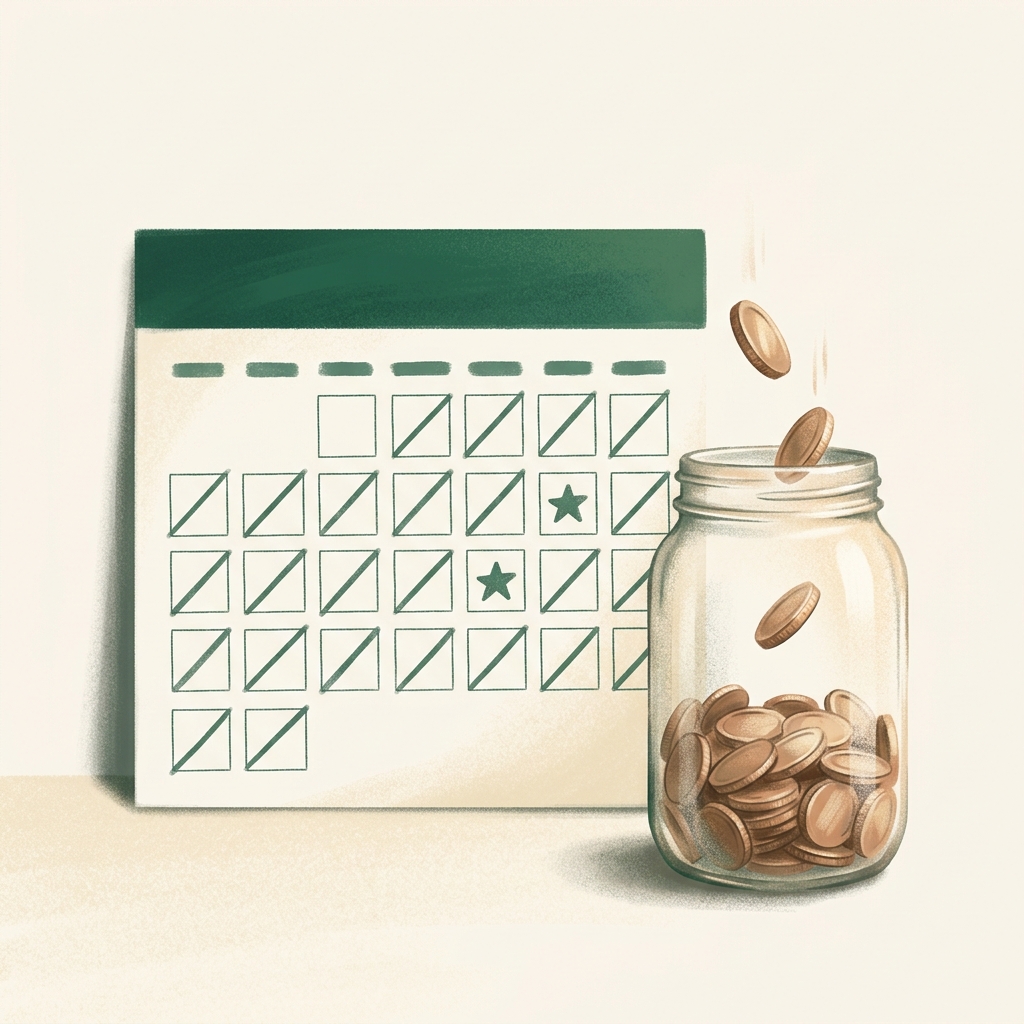
Mark each day spend-free as you go. The two "planned exception" boxes are your pre-committed exceptions from the section above — using one doesn't break the challenge, it's already part of the plan.
30-day no-spend tracker
Planned exceptions (decided in advance, don't break the streak)
What quietly derails it
- Grocery creep. "No shopping" quietly becomes "just a few extra things at the grocery store" — see our guide to cutting monthly expenses for spotting that specific leak.
- Subscriptions running in the background. A subscription is still spending even though it doesn't require a decision that day. Temporarily setting your fun money allowance to $0 for the month, rather than trying to remember not to spend it, removes the decision entirely.
- Treating one spent day as the whole month failing. One slip doesn't erase the other 29 — the point is the pattern, not a perfect record. See our guide on building a budget you won't abandon for the same idea applied to any system, not just this one.
Not to be confused with the 30-day delay rule
The 30-day delay rule pauses one specific purchase at a time, indefinitely — this challenge pauses all non-essential spending for a fixed, defined window. They work well together: use the delay rule year-round, and run a no-spend month as an occasional reset.
After the 30 days
Once the tracker is full, decide what's next: redirect what you saved into a bigger goal like the 52-week $5,000 challenge or your first $1,000 emergency fund, or just bank the win — see our guide on why small financial milestones deserve real celebration. Either way, a completed no-spend month is proof the habit is possible, which matters more than the dollar amount alone.
Prefer working from paper?
This challenge is also available as a printable in the 30-Day No-Spend Challenge printable ($4) in the PocketProof Etsy shop — a daily log for what you were tempted to buy, the 24-hour rule built in, and a results page with reflection questions once the 30 days are up.