 PocketProof
A $7,500 month and a $3,200 month from the same freelance income can't follow the same budget. Forcing them into one is why most variable-income budgets collapse by month three.
Why traditional budgeting fails variable earners
Most budgeting advice assumes a number that doesn't change: the same paycheck, the same date, every two weeks. Freelancers, gig workers, commission-based sales professionals, and small business owners don't have that number. So the common workaround is to average it out — add up a few months, divide by the count, and budget against that average.
That average is a trap. In a $3,200 month, a budget built around a $5,350 average leaves you short on rent. In a $7,500 month, that same average makes you feel richer than you are, so the extra gets spent instead of saved, because "average" doesn't warn you that next month might not hit it.
Percentage-based rules like 50/30/20 have the same blind spot in a different form: 50% of a good month is a healthy number, but 50% of a bad month might not cover your actual rent. The percentage moves with your income. Your rent doesn't.
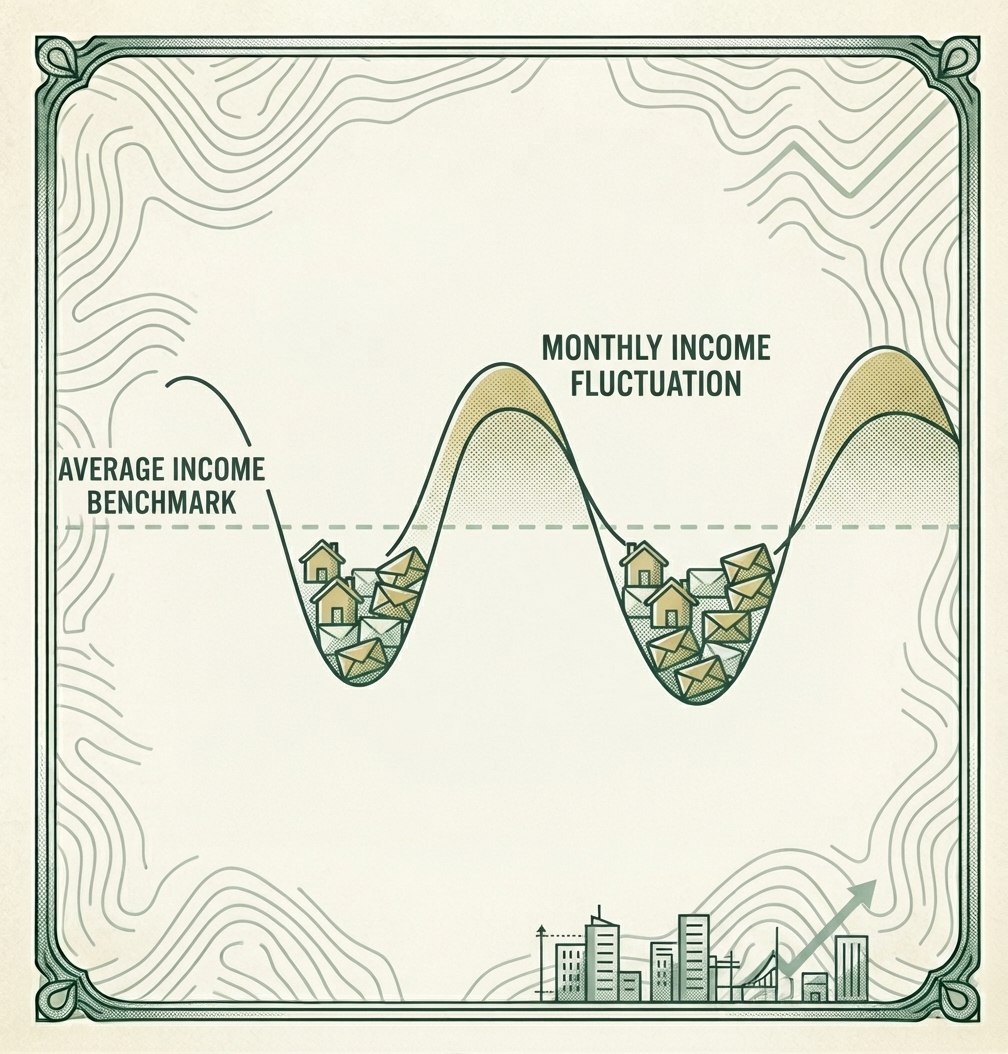
The Lowest Month Baseline Rule
Instead of budgeting against your average, budget against your floor. The Lowest Month Baseline Rule uses two numbers:
The formula
- Baseline Needs = Non-Negotiable Expenses + Minimum Debt. Housing, utilities, basic groceries, insurance, and minimum debt payments — the amount you must cover no matter how the month goes.
- Hill-and-Valley Buffer Target = Baseline Needs × 1.5. The cash reserve that exists specifically to cover the gap in a low month without touching taxes or debt.
Once you know your Baseline Needs, that number becomes non-negotiable — it gets funded first, every month, before taxes, before savings goals, before anything discretionary. Everything else in this framework is built around protecting that number.
Traditional budgeting vs. the Tiered Variable Waterfall
| Traditional 50/30/20 | Tiered Variable Waterfall | |
|---|---|---|
| Calculated against | A single monthly figure (often an average) | Your lowest realistic month |
| High-income months | Percentages scale up automatically | Extra funds flow to tax reserve, then buffer, then goals — in that order |
| Low-income months | Percentages shrink, but fixed bills don't shrink with them | Baseline needs are funded first, before anything else |
| Tax handling | Not addressed | Built-in reserve tier, calculated on every payment |
| Risk | Can look balanced on paper while missing rent in a bad month | Designed so a bad month never breaks baseline needs |
The 3-tier spending waterfall strategy
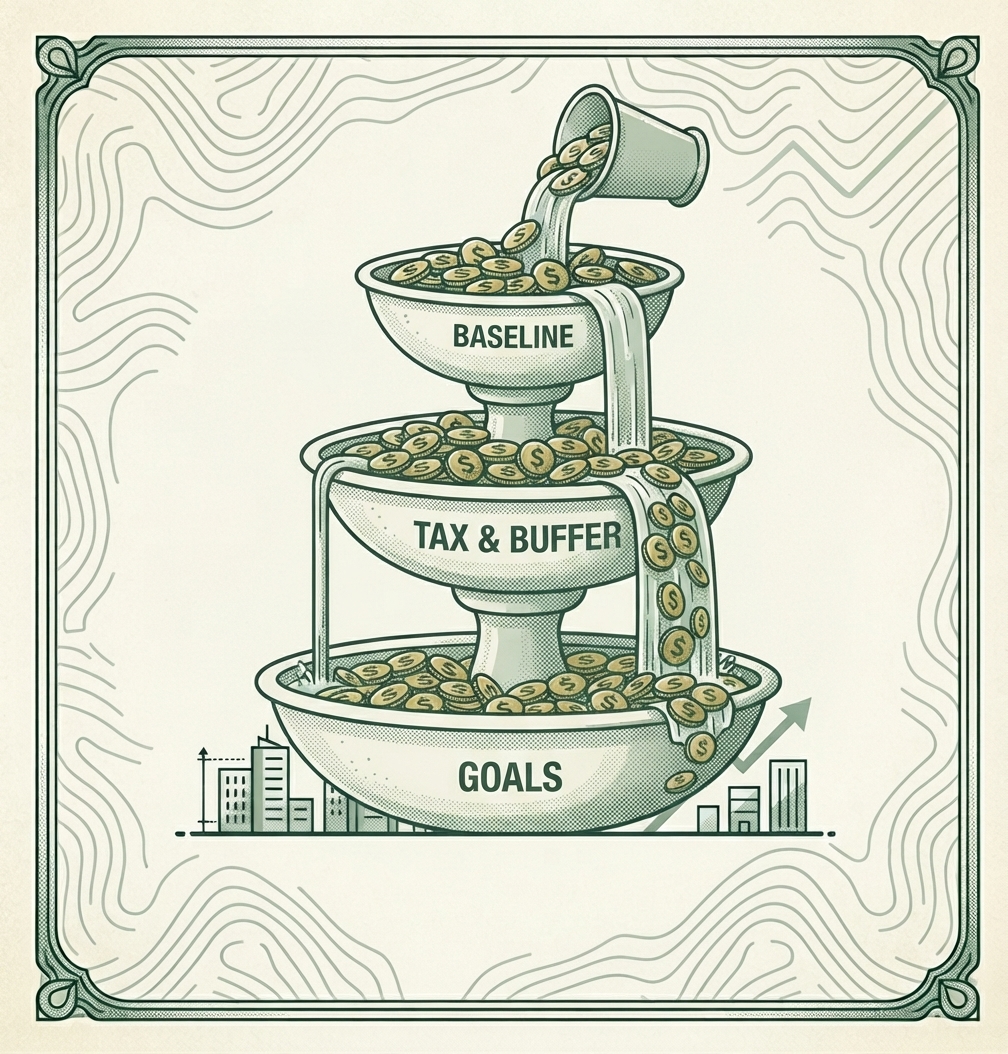
Every payment you receive flows through three tiers, in strict order. A lower tier only gets funded once the tier above it is covered — that's what makes it a waterfall, not a percentage split.
Tier 1: Survival baseline
Housing, utilities, basic food, minimum debt payments. This is your Baseline Needs number from the formula above, and it is funded first, in full, before you do anything else with the money — including paying yourself for a good month's work.
Tier 2: Tax reserve & "valley" buffer account
Two jobs live in this tier, and they compete for the same dollars. Tax reserve comes first — a fixed percentage (commonly 25-30%) of every payment, set aside the moment it's funded, not at tax time. Whatever's left in this tier after tax reserve goes toward the Hill-and-Valley Buffer until it hits its 1.5× target. In a lean month, tax reserve gets priority inside this tier; buffer contributions may drop to zero. That's expected — it's what the buffer is for.
Tier 3: Goals, investments & discretionary spending
Whatever's left after Tiers 1 and 2 are funded. In a strong month, this can be a meaningful number. In a lean month, it's often zero — and that's the system working correctly, not failing. The whole point of the waterfall is that discretionary spending is the shock absorber, not rent.
Case study: how Alex managed a $4,300 income swing
Alex is a freelance designer whose monthly income has ranged from $3,200 in a slow month to $7,500 in a strong one — a $4,300 swing on the exact same business. Here's the baseline math, then both months run through the waterfall.
Step 1: Calculate the baseline
- Rent: $1,400
- Utilities, phone & internet: $250
- Groceries: $400
- Health insurance: $200
- Minimum student loan payment: $250
Baseline Needs = $2,500. Buffer Target = $2,500 × 1.5 = $3,750.
How to actually find your "lowest realistic month": pull 12 months of income if you have them, and use the lowest one — or, if you have two or more years of history and one month was a genuine outlier (a client loss, a medical gap), use your 10th-percentile month instead so the whole plan isn't anchored to a single freak event. With less than 12 months of history, be conservative and lean toward your worst month rather than a typical one; you can always loosen the baseline later once you have more data.
| Tier | High month ($7,500) | Low month ($3,200) |
|---|---|---|
| Tier 1 — Baseline needs | $2,500 | $2,500 |
| Tier 2 — Tax reserve (25% of gross) | $1,875 | $700 (short $100 of the full $800 owed) |
| Tier 2 — Buffer contribution | $3,125 | $0 |
| Tier 3 — Goals & discretionary | $0 | $0 |
| Total | $7,500 | $3,200 |
In the high month, Alex's baseline is covered with $5,000 to spare — tax reserve gets fully funded, and the full $3,125 that's left goes toward the $3,750 buffer target, since buffer isn't yet full and gets priority over goals under the waterfall's own order. Tier 3 goals is $0 this month — not a failure, just the buffer not being topped off yet. In the low month, baseline still gets covered in full, tax reserve gets nearly funded (Alex is $100 short, made up easily out of a future strong month), and both buffer and discretionary spending simply pause. Nobody misses rent. Nothing goes on a credit card to cover the gap.
Once Alex's buffer account reaches its full $3,750 target — which happens after about one strong month at this pace, since a single high month funds $3,125 of it outright — the next slow month works differently: instead of shorting the tax reserve, Alex pulls the $100–$800 gap straight from the buffer, funds tax reserve in full, and keeps the system's real purpose intact. Once buffer is full, high months also start actually funding Tier 3 goals, since there's no longer anywhere else for the leftover to go. That's the actual payoff of the Hill-and-Valley Buffer: it turns a low month from a scramble into a non-event.
The math needs to be consistent more than it needs to be exact. Pull your own numbers for Baseline Needs, run one good month and one bad month through the same three tiers, and you'll know within twenty minutes whether your current setup would survive your worst realistic month, or just your average one. If you're starting the Hill-and-Valley Buffer from zero, our emergency fund guide covers the same idea from the ground up — it's the same reserve by another name.
Run your own waterfall
Plug in your own baseline, buffer, and this month's income to see exactly how it flows through the three tiers.
Tiered waterfall planner
Defaults match Alex's case study above.
Strict tier order: baseline, then tax reserve, then buffer until it's full, then goals. Goals will read $0 in plenty of real months — that's the system working, not failing.
Want this tiered system built for you?
The PocketProof Budget System ($15) is an Excel & Google Sheets budget spreadsheet with an automatic dashboard — log what actually came in and went out each month, and it recalculates your numbers instead of you rebuilding a formula every time income changes.